
News
President Tinubu ends 29-year wait, elevates 16 FCT chiefs, to upgrade palaces

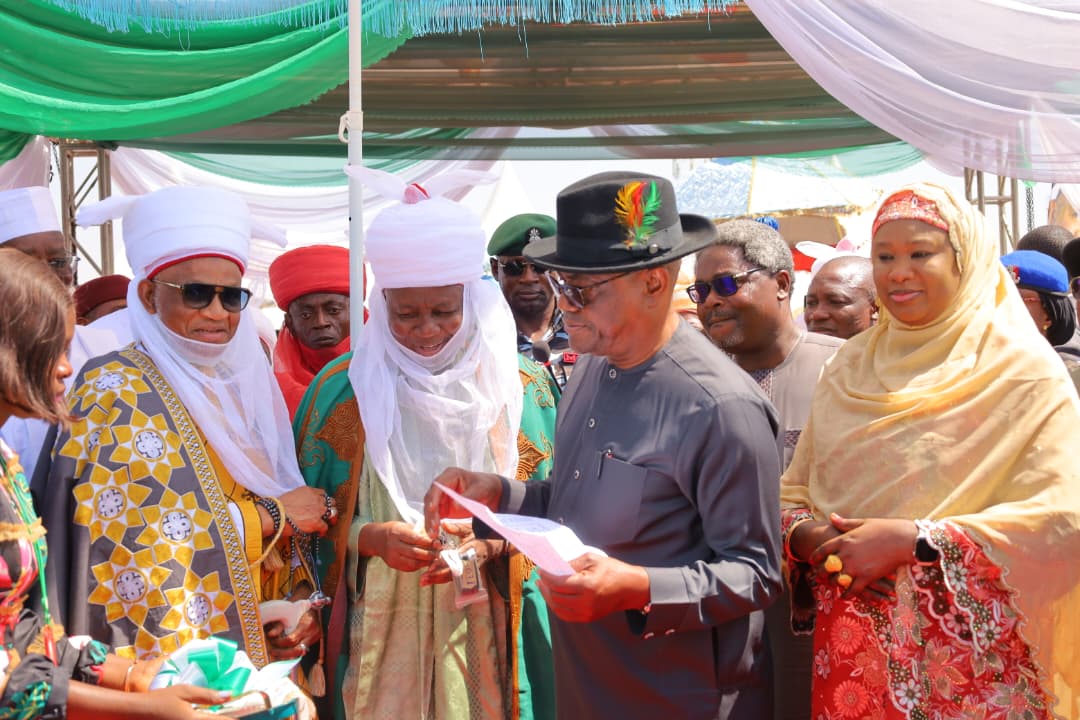
The Federal Capital Territory Minister, Ezenwo Nyesom Wike, has announced plans to upgrade more traditional chiefdoms and build befitting palaces for first-class traditional rulers in the 2027 budget, as the Tinubu administration moves to restore dignity to traditional institutions in Abuja.
The Minister made the pledge on Friday, November 20, 2026, in Abuja during the presentation of certificates, letters of office, staff of office and brand-new sports utility vehicles (SUVs) to newly upgraded first- and second-class traditional rulers from 16 chiefdoms in the territory.

The ceremony, attended by senators, monarchs, political leaders and stakeholders, marked the end of nearly three decades of agitation for the elevation of traditional stools in the FCT.
The Minister recalled that since the creation of the FCT Traditional Rulers Council in 1997, only the stool of the Ona of Abaji had been elevated, leaving other royal fathers waiting in vain despite their service to their communities.

“Today is 29 years after the creation of the FCT Traditional Rulers Council. Since 1997, there’s only one stool that was elevated, and that is the Ona of Abaji. Since that period, no stool has been elevated”, Wike said.
He said the breakthrough was made possible by President Bola Ahmed Tinubu, who under the Renewed Hope Agenda approved the elevation as part of his programme of inclusivity.
“Mr President, as part of his programme of inclusivity under the Renewed Hope Agenda, thought it wise to bring the traditional rulers close, for them to also stand and be part of the governance process. Mr President approved the elevation of the various stools”, he said.
Defending the provision of official vehicles to the monarchs, the Minister dismissed criticisms that the gesture amounted to bribery, describing such claims as a failure to appreciate the role of traditional rulers.
“I’ve had so many people ranting in the various media houses that we intend to pay them bribes. It’s unfortunate. Special assistants to Ministers, to the President have vehicles, but the traditional institution should not have vehicles. Giving them vehicles means to pay them bribes”, he queried.
He added: “That’s how we have kept our traditional institution so low, that you see a traditional ruler on a bike or on a tricycle. That’s what we want for our system. If this is a bribe, we’ll continue to pay it”.
The Minister insisted that traditional rulers remain indispensable to governance, particularly in stabilising communities and creating an enabling environment for government projects.
“Traditional institutions play a lot of roles to stabilise communities for the government to carry out their projects. If traditional rulers cannot organise their communities, you will see the level of insecurity in this country”, he said.
He recalled that shortly after inauguration in 2023, President Tinubu directed us to visit the six Area Councils, consult traditional rulers and identify their needs, leading to interventions in roads, police stations and accommodation for security personnel.
In the next phase, the Minister disclosed that more chiefdoms would be upgraded in the coming months, and that palaces for first-class chiefs would be captured in the 2027 budget before extension to second-class chiefs.
“I do agree with you. By the grace of God, in the next 2027 budget, we’ll see what the funds can take and make sure that, at the end of the day, all the first-class chiefs are taken care of. Then we’ll move to the second class”, he said.
He also charged chairmen of the six Area Councils to provide logistics, particularly fuel, to ensure the newly presented vehicles are effectively utilised by the royal fathers.
Speaking at the event, Chairman of the Senate Committee on FCT, Senator Ibrahim Mohammed Bomai, congratulated the monarchs and urged them to justify the confidence reposed in them through fair, inclusive leadership and by giving women and youths a voice in community decisions.
Similarly, Chairman of the Senate Committee on FCT Area Councils and Ancillary Matters, Senator David Jimkuta, commended Tinubu and Wike for restoring recognition to the traditional institution, saying the vehicles would improve mobility and grassroots reach.
In her remarks, Minister of State for the FCT, Dr Mariya Mahmoud, described the presentation as a major milestone in strengthening traditional institutions, and urged residents to appreciate the administration’s efforts, asking, “If not Bola Ahmed Tinubu, who?” to which the audience responded, ” Tinubu”.
The Etsu Nupe, Alhaji (Dr.) Yahaya Abubakar, who chairs the coordinating committee of the National Council of Traditional Rulers of Nigeria, said the vehicles would address the longstanding challenge of travelling across domains, but warned that new status must be matched with leadership capacity and dedication to service.
On behalf of the FCT Council of Chiefs, the Ona of Abaji, His Royal Majesty, Alhaji (Dr.) Adamu Baba Yunusa, commended the Minister for restoring dignity to the institution, while the Sarkin Karshi, Alhaji Ismaila Mohammed, speaking for the newly upgraded first-class chiefs, described the elevation as the fulfilment of a struggle spanning nearly three decades, noting that some agitators since 1997 died without witnessing it.
The Emir of Jiwa, His Royal Highness, Alhaji (Dr.) Idris Musa, speaking for the second-class chiefs, urged monarchs to understand that relevance is not determined by rank alone but by capacity to serve, maintain peace and develop communities.
In her welcome address, the Director of Administration and Finance, Area Council Services Secretariat (ACSS), Omolola Olanipekun, described the ceremony as a historic correction of a longstanding gap, noting that traditional rulers had served as custodians of culture, mediators and promoters of peace despite the delay, and would now enjoy recognition comparable to their counterparts in other states.








NAN Staff appointed Media Director, Ashaka Carnival Group
Mr Emmanuel Mogbede, an Assistant Editor in Chief of the News Agency of Nigeria (NAN)has been appointed as the Director...


Ayra Starr joins 2027 Coachella lineup alongside Dua Lipa, SZA, Madonna
Nigerian singer Ayra Starr has been named among the artistes scheduled to perform at the 2027 edition of the Coachella...


Blessing CEO admits faking cancer diagnosis to raise donations
Social media personality says financial pressure prompted fundraising stunt Social media personality Blessing Okoro, popularly known as Blessing CEO, has...

Tinubu’s praise singer Rarara assaulted by worshippers at Abuja National Mosque

2027: Opposition parties to suspend campaigns for coalition summit November 30

Defence Minister Musa, Shettima, Obasanjo, Mahama wttend Jim Ovia’s 75th birthday dinner

President Tinubu ends 29-year wait, elevates 16 FCT chiefs, to upgrade palaces
Yeebo Announces Interim Results for FY26/27 Revenue Increases by 45.5% to HK$806.7 Million Profit Attributable to Owners Surges 87.6% to HK$2,284.7 Million

Ebola: Tinubu gov’t tells Nigerians not to panic

APC ‘rented crowds’ to fill ’empty seats’ at Kaduna rally – Opposition ADC claims

Harry Kane of Bayern Munich is winner of 2026 Ballon d’Or after display – Arsenal Midfielder Declan Rice deckares

Protest looms as PAAU increases school fees over 150% amid NELFUND intervention confusion [Investigation]

UbuntuCare Africa introduces ‘Gift Health’ to Nigerians at OffChart NXT 2026

BREAKING: Suspected ‘Abu Odoma boys’ set Maikano Diesel Generator donated by Muri ablaze overnight at Idah LG

Research funding: Union demands 5% tax from 14 MDAs

2023: Senator Marafa, Ex-governor Yari defect to PDP
