
Foreign
Netanyahu agrees to serve under Eisenkot as alternate prime minister in proposed unity deal

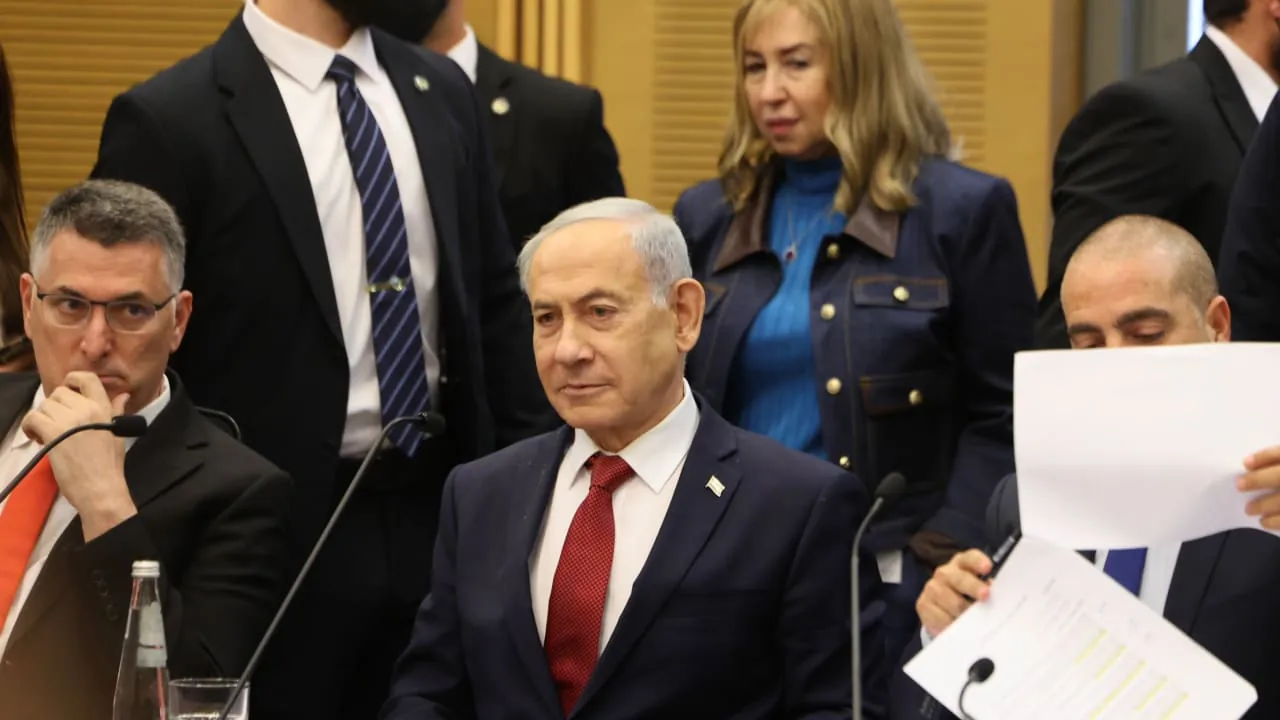
Netanyahu said he was willing to let Gadi Eisenkot serve as prime minister first in a proposed unity government, with the prime minister taking the role of alternate PM.
Prime Minister Benjamin Netanyahu confirmed for the first time that he was willing to allow Yashar party leader Gadi Eisenkot to serve as prime minister first in a proposed national unity government, with Netanyahu serving as alternate prime minister, in a statement published on Saturday.

Netanyahu said he believed he should naturally lead a unity government as head of the largest party; he was prepared to set aside this principle “given the magnitude of the existential threat and the possibility that a government incapable of confronting this threat will be formed, my responsibility as a leader requires me to set everything aside.”
Netanyahu added that he was willing to agree to Eisenkot serving first as prime minister while he served as alternate prime minister at the beginning of the term.

Netanyahu called for the two sides to “immediately begin genuine, sincere and accelerated negotiations,” saying he expected a “similar willingness to compromise and make concessions” from Eisenkot’s side.
He said the proposed unity government would work to “repel these threats and safeguard Israel’s security and future.”
Prime Minister Benjamin Netanyahu delivers a statement to the media at the Knesset in Jerusalem, November 25, 2026.
In response to Netanyahu’s claims, Eisenkot said that if the prime minister is serious about his commitment to national unity, he should meet him on Saturday evening in Herzliya for coalition negotiations.
“This past Sunday, a detailed proposal was conveyed to Netanyahu through a secret channel established at his request, addressing substantive issues,” Eisenkot said. “For about three weeks now, my team and I have been proposing and trying to conduct genuine, sincere and accelerated negotiations, but we are met with refusal and evasion.”
“In the time that has passed, the basic guidelines of the government that I intend to swear in in the coming days have been formulated, and they will serve as the basis for any future government I lead.”
“If Likud is genuinely committed to unity, I am prepared to test the seriousness of its intentions over the next 24 hours. I invite Netanyahu and his team to join me tonight at the Dan Accadia Hotel in Herzliya, where I am with my negotiating team, to conduct genuine and accelerated negotiations on governing principles and policy issues, based on the detailed proposal to which Netanyahu has yet to respond.”
Likud responded on Saturday, saying Netanyahu and Eisenkot spoke and agreed to meet at the Dan Accadia Hotel in Herzliya at 10 a.m. on Sunday morning.
Eisenkot met with Avigdor Liberman of Yisrael Beytenu at the Dan Accadia Hotel on Saturday night, ahead of the scheduled Likud meeting.
How many seats does Eisenkot have?
As a reminder, Eisenkot recently signed coalition agreements with Golan’s Democrats and Liberman’s Yisrael Beytenu, bringing his total to 36 seats.
If Likud and Yashar can reach an agreement, Eisenkot may be able to secure himself a 63-seat majority without any haredi or Arab parties, and could potentially reach as high as 82 if Naftali Bennett’s B’Yachad and Finance Minister Bezalel Smotrich’s Religious Zionist Party join.
Notably, Netanyahu is reportedly not seeking an immediate rotation in a unity government. The prime minister claimed that he wants to resolve a sensitive security issue currently on the agenda, only after which the rotation would take effect.
This not only introduces further complications into such a government, but could lead to Netanyahu’s offer being rejected quickly by the Eisenkot bloc.
What is an alternate prime minister?
The position of alternate prime minister was established in 2020 as part of the rotation agreement between Benjamin Netanyahu and then-Blue and White chairman Benny Gantz, through an amendment to Basic Law: The Government.
The role carries a special legal status that distinguishes it from that of an ordinary cabinet minister. While Israeli legal precedent requires ministers to resign if indicted on serious criminal charges, the same restriction does not apply to the prime minister or alternate prime minister, allowing Netanyahu to hold the latter position despite the ongoing criminal proceedings against him.
The arrangement was intended to enable Netanyahu to remain in government after handing over the premiership to Gantz, though the rotation ultimately never materialized.
Lapid, Golan reject Netanyahu’s proposal
After Netanyahu proposed joining a unity government under Eisenkot’s leadership as alternate prime minister, Eisenkot invited Netanyahu and his negotiating team to renewed coalition talks on Saturday, saying he was prepared to assess the seriousness of Likud’s intentions.
“If Likud is ready for genuine unity, I am ready to assess the seriousness of its intentions over the next 24 hours,” Eisenkot wrote in a post on X, inviting Netanyahu and his team to meet him that evening at the Dan Accadia Hotel in Herzliya.
Eisenkot said a detailed proposal had been conveyed to Netanyahu through a secret channel established at Netanyahu’s request, including “significant compromise positions” on several issues. However, he said, “to this very moment, we have received no response on these issues.”
B’Yachad deputy Yair Lapid and Democrats chairman Yair Golan both criticized Netanyahu’s proposal, decrying the prime minister’s statement as a “con.”
“Netanyahu’s proposal is yet another transparent con by a serial fraudster who has cheated every partner and broken every agreement,” Lapid wrote.
Lapid argued that a government headed by Eisenkot must first be sworn in before any negotiations regarding its potential expansion could take place.
Golan, meanwhile, called on political leaders to respect the election results and move forward with forming a government without Netanyahu.
“Enough with the stunts and tricks. Netanyahu lost,” Golan wrote. “It is our duty to respect the will of the voters and form a government of change and salvation.”
Finance Minister Bezalel Smotrich, meanwhile, welcomed Netanyahu’s proposal, saying he had been involved in the prime minister’s deliberations in recent days and was prepared to act as a guarantor for any agreement reached with Eisenkot and his political partners.
“Prime Minister Netanyahu’s offer of unity is genuine and sincere. I know this as someone who has spent many hours discussing the matter with him in recent days and was involved in the deliberations and the decision,” Smotrich wrote on X.
Smotrich called on Eisenkot and Zionist lawmakers on the Left to abandon efforts to establish a minority government reliant on those he described as “enemies of Israel.”
He urged them instead to reciprocate Netanyahu’s offer and establish a broad national unity government.
UTJ official: Netanyahu’s offer to serve second will not advance a draft law, alienates haredi parties
A senior United Torah Judaism (UTJ) official criticized Netanyahu’s offer, accusing the prime minister of abandoning his haredi political partners to secure a coalition with Eisenkot, Bennett, and Lapid, Walla reported.
“Bibi is now actively working against those who protected him over all the past years,” the official said, adding that a government formed around the “Alliance of Those Who Serve” would leave the haredi parties outside the coalition and would not advance a draft law.




BREAKING: Nollywood King Pete Edochie dies at 79
Nollywood King and father, Pete Edochie is dead. He died at the age of 79. His family confirmed that he...


‘I have pedigree’ — Aki reacts to cheating allegations
Popular Nollywood actor Chinedu Ikedieze, popularly known as Aki, has reacted to those accusing him of cheating in his marriage,...


Australian music legend Molly Meldrum dies at 83
Australian music legend Molly Meldrum has died at the age of 83 following a long illness. The veteran music promoter...

Hearts Connect Through Images, Youthful Voices Echo Through The Silk Road! The Fifth Silk Road International Youth Photography and Short Video Competition Honors Its Winners

Senator Idiat Adebule dies at 56, Tinubu, APC mourn

Netanyahu agrees to serve under Eisenkot as alternate prime minister in proposed unity deal

Tinubu has taken Nigeria out of ‘Intensive Care Unit’ to recovery – Wike

Come to Singapore, Understand Asia: Singapore as a Gateway to the Region

Tinubu approves SUVs for FCT monarchs as Wike declares operation deliver your polling units

Nollywood Actress, Bimbo speaks about Funke Akindele’s ugly past before her shining time

TotalEnergies sells 40% interest in OPL257 offshore Nigeria

OAGF urges heads of agencies to assume greater responsibility of personnel budgets, nominal rolls

President Tinubu ends 29-year wait, elevates 16 FCT chiefs, to upgrade palaces

BREAKING: Suspected ‘Abu Odoma boys’ set Maikano Diesel Generator donated by Muri ablaze overnight at Idah LG

Research funding: Union demands 5% tax from 14 MDAs

2023: Senator Marafa, Ex-governor Yari defect to PDP
