
News
EFCC trains 227 CCB officers on investigation, asset recovery, digital evidence

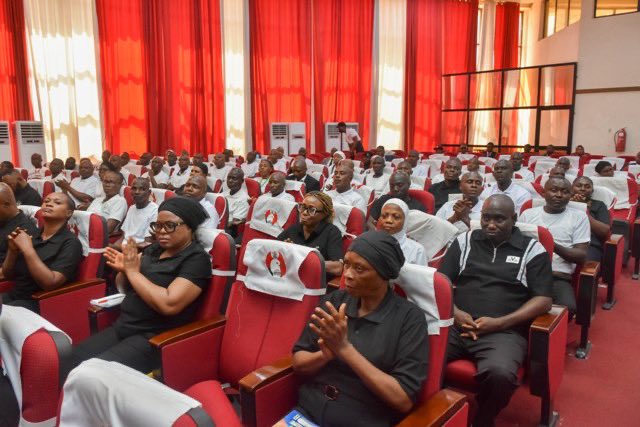
The Economic and Financial Crimes Commission (EFCC) has commenced a three-week capacity development programme for 227 management and senior staff members of the Code of Conduct Bureau (CCB), as both agencies seek to strengthen institutional capacity, accountability and the fight against corruption in Nigeria.
The officers were formally admitted into the EFCC Academy in Karu, Abuja, on Monday, November 16, 2026, for the training, which is designed to enhance their professional competence, investigative skills and understanding of emerging demands in public service.

Speaking at the flag-off ceremony, EFCC Executive Chairman, Ola Olukoyede, represented by the Acting Commandant of the EFCC Academy, Assistant Commander of the EFCC I, Joseph Ogwiji, described the programme as another milestone in the longstanding collaboration between the two agencies.
He noted that the partnership remained important to strengthening integrity, accountability, transparency and good governance in the country.

The training is expected to equip participants with relevant knowledge and practical skills to improve their effectiveness in carrying out their statutory responsibilities.
In his remarks, CCB Chairman, Dr Abdullahi Usman Bello, expressed appreciation to Olukoyede and the management and staff of the EFCC for their continued cooperation, particularly in the area of staff development.
Bello said the decision to conduct the training at the EFCC Academy was informed partly by feedback received from CCB personnel, stressing the need to update officers’ knowledge and align their professional orientation with the changing demands of the Bureau.
He identified orientation and discipline as two critical priorities for the institution, explaining that the nature of the Bureau’s work had evolved and required personnel to acquire the appropriate skills to perform their duties effectively.
“Many of you have served CCB for a very long time, but the work at CCB has changed and also CCB is changing,” he said.
The CCB chairman urged participants to embrace the training with the right attitude and allow it to reshape their approach to official responsibilities.
He emphasised that staff should not be expected to perform duties for which they had not received adequate training, noting that institutional effectiveness required deliberate investment in personnel development.
Bello also highlighted discipline as an essential factor in translating knowledge into productive outcomes, urging the officers to demonstrate professionalism and commitment throughout the programme.
Also speaking, Kenneth Ikpeme, a member of the CCB Board of Directors, underscored the importance of continuous capacity development in preparing public officers for increasingly demanding responsibilities.
Ikpeme encouraged the participants to make the most of the opportunity, acquire relevant knowledge and build the competence needed to discharge their duties effectively.
“My admonition to you now is that you take advantage of this exercise. Equip yourself because the task ahead of you is quite enormous,” he said.
The three-week programme covers several specialised areas, including leadership, advanced investigation and case management, forensic intelligence and digital evidence, asset tracing and recovery, and financial analysis.
The inclusion of these subjects is expected to strengthen the officers’ professional capacity in handling complex cases, analysing financial information and applying modern investigative techniques within their respective areas of responsibility.
The programme also highlights the importance of inter-agency cooperation and sustained investment in personnel development as public institutions seek to improve performance and reinforce accountability.
The EFCC and the CCB have complementary responsibilities in promoting integrity in public service and addressing corruption-related concerns. The training provides an opportunity to deepen cooperation between the institutions while improving the skills of personnel responsible for carrying out their mandates.
The initiative comes amid continuing calls for stronger institutional capacity, professional discipline and effective enforcement of accountability standards across Nigeria’s public sector.

NAN Staff appointed Media Director, Ashaka Carnival Group
Mr Emmanuel Mogbede, an Assistant Editor in Chief of the News Agency of Nigeria (NAN)has been appointed as the Director...


Ayra Starr joins 2027 Coachella lineup alongside Dua Lipa, SZA, Madonna
Nigerian singer Ayra Starr has been named among the artistes scheduled to perform at the 2027 edition of the Coachella...


Blessing CEO admits faking cancer diagnosis to raise donations
Social media personality says financial pressure prompted fundraising stunt Social media personality Blessing Okoro, popularly known as Blessing CEO, has...

SoSIM launches contract-free “One Number Watch” data package

EFCC trains 227 CCB officers on investigation, asset recovery, digital evidence

Galaxy Resort Presents: “Plácido Domingo & José Carreras: The Legends United Opera Gala”

Disney and Visa Announce Multi-Year Strategic Alliance Across Asia Pacific

China-Indonesia Cultural Industry Exchange Symposium Held in Jakarta

Court sentences christian mother to 14 years imprisonment for sharing faith with muslim woman

‘Suspend frequent travels in pursuit of money and attend to me’, heavily pregnant Jarvis to Peller

Nigeria meets OPEC quota for 5th consecutive month as daily peak hits1.84m barrels in September

Ebola: Tinubu gov’t tells Nigerians not to panic

The silent killer among Nigeria’s youth

BREAKING: Suspected ‘Abu Odoma boys’ set Maikano Diesel Generator donated by Muri ablaze overnight at Idah LG

Research funding: Union demands 5% tax from 14 MDAs

2023: Senator Marafa, Ex-governor Yari defect to PDP
