
News
FG launches literacy revolution to target 80 million non-literate Nigerians

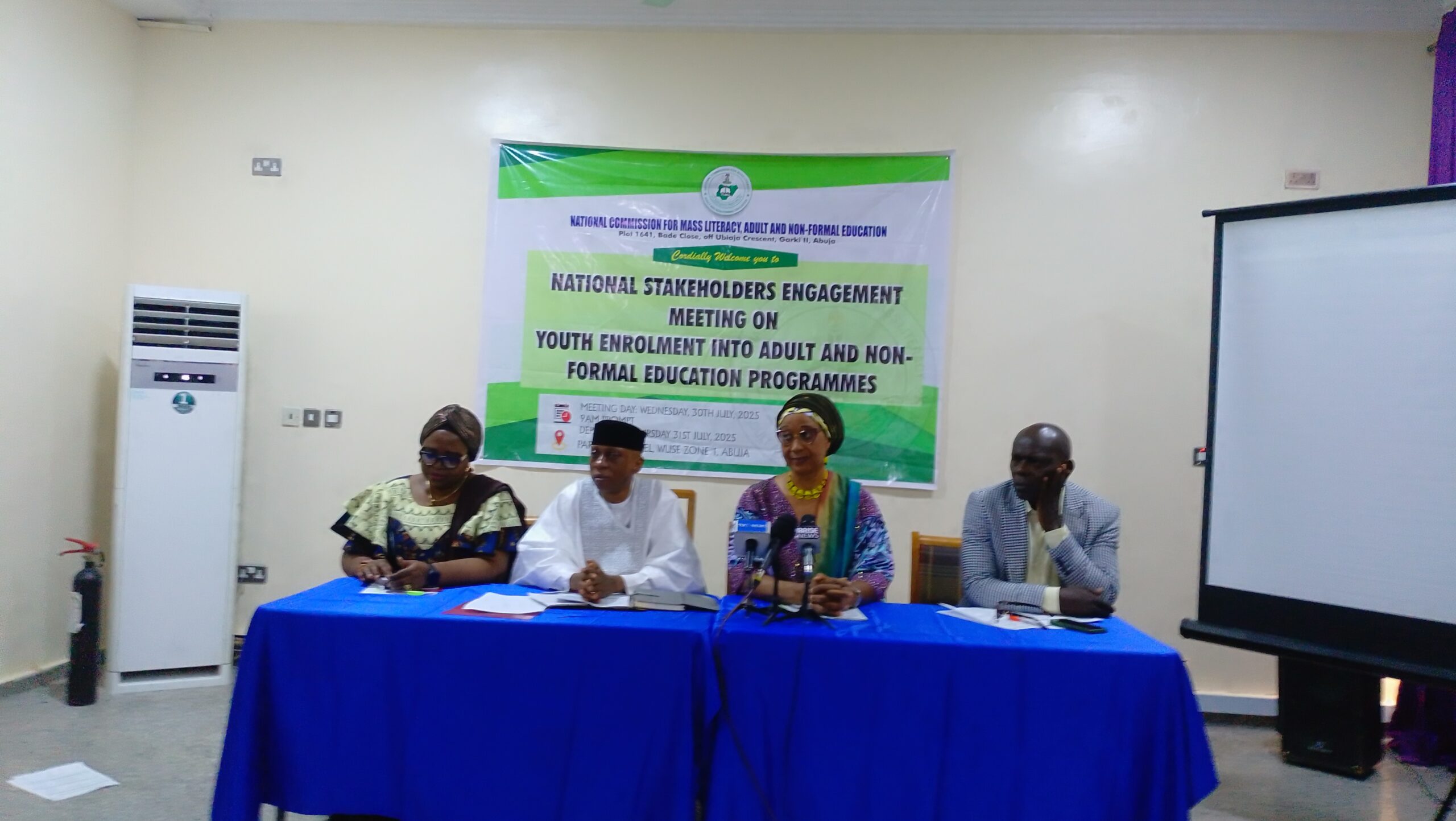
The Federal Government has officially launched the Accelerated Basic Education (ABE) programme, an ambitious national initiative aimed at delivering basic literacy to nearly 80 million underserved, non-literate youths and adults across Nigeria.
The Minister of State for Education, Prof. Suwaiba Ahmad made the launch at a one-day National Stakeholders Engagement Meeting on Youth and Adult Literacy held Wednesday in Abuja.

According to a 2022 report by the National Bureau of Statistics (NBS), approximately 80 million Nigerians—representing about 31% of the country’s estimated 250 million population—are still non-literate.
Represented by her Special Assistant on (Technical), Dr Claris Ujam, the Minister lamented that millions of Nigerians remain shut out of basic education hence the need for the Accelerated Basic Education programme.

She said the programme, tagged ABE, is designed to reach learners in all six geopolitical zones without compromising the quality, inclusiveness, or relevance of education delivery.
Speaking, she said, “Your presence here today is a resounding affirmation of our collective resolve to reshape Nigeria’s educational future, especially for our underserved youth and adult populations.
“As you are well aware, education forms the bedrock of every prosperous and inclusive society. Yet far too many of Nigeria’s millions—youths and adults—still remain outside the reach of basic literacy. This silent crisis suppresses individual potential and stalls national progress.”
The Education Minister emphasized that President Bola Tinubu’s administration is committed to creating learning opportunities that transcend barriers such as age, location, and social circumstance.
According to her, “The ABE programme is more than a solution; it is a movement. A movement that rejects age, geography, and circumstance as barriers to learning. We are here to mobilize. Our goal is bold: to scale youth and adult enrolment in literacy programmes across every state, every community, every ward. Achieving this requires your expertise, your reach, and your enduring commitment.”
The minister further urged Non-Governmental Organizations (NGOs) and development partners to intensify community-based initiatives, adopt innovative delivery methods, and work with government to reach the unreached.
“As a Ministry, we reaffirm our promise to enable this work with sound policies, sustained financing, and strict accountability mechanisms,” she added, noting that “every adult the country empowers to read becomes a better-informed citizen while every youth who gains access to education becomes a change maker”, she emphasized.
She however stressed that the launch marks not just the rollout of a programme but the transformation of lives, charging participants to go beyond dialogue and foster partnerships, commitments, and strategies to make literacy a universal and life-changing tool.
Also speaking at the event, Dr John Edeh, Coordinator of the workshop and Director of Literacy and Development at the National Commission for Mass Literacy, Adult and Non-Formal Education, described the stakeholders’ meeting as a timely forum for reflection, collaboration, and concrete action.
In his words, “We are here because we recognize a pressing challenge: millions of young Nigerians remain outside the formal education system. Whether due to poverty, early school leaving, displacement, or other socio-economic barriers, these youths deserve a second chance. The Adult and Non-Formal Education sector is that gateway.”
Dr Edeh explained that the sector is uniquely equipped to serve diverse learners through inclusive and adaptable strategies—ranging from foundational literacy to life skills, vocational training, digital education, and civic empowerment.
He added that the Commission is committed to reaching learners “where they are—physically, emotionally, and socially”, emphasizing that the goal is not remedial education but “transformative education.”
Dr Edeh affirmed the Ministry’s dedication to expanding access, improving quality, and reinforcing institutional capacity within the Adult and Non-Formal Education sector in line with the National Policy on Education, the Ministerial Strategic Plan, and the Sustainable Development Goal 4 (SDG 4): inclusive and equitable quality education and lifelong learning for all.
He listed the Commission’s key focus areas as increased funding and resource mobilization, strengthened partnerships with state actors and civil society, enhanced data and accountability mechanisms, the use of youth-friendly and tech-driven learning models, and the integration of digital tools into non-formal learning spaces.
Dr Edeh called for broad-based collaboration stating that all hands must be on deck to create a safe, inclusive, and gender-sensitive learning environment to enable the Commission to engage the youth not just as learners, but as co-creators of solutions.





Australian music legend Molly Meldrum dies at 83
Australian music legend Molly Meldrum has died at the age of 83 following a long illness. The veteran music promoter...


Frank Edwards: I could have owned three private jets if I had yielded to temptation
Gospel singer recounts how he rejected a lucrative music deal that required him to replace the name of Jesus with...


NAN Staff appointed Media Director, Ashaka Carnival Group
Mr Emmanuel Mogbede, an Assistant Editor in Chief of the News Agency of Nigeria (NAN)has been appointed as the Director...
Dangote Coal awards scholarships to 42 Kogi students, pays annual surface rent

AS Watson Uses AI to Boost Availability and Speed Up Retail Supply Chain

Akpabio: Akwa Ibom united behind Tinubu’s 2027 re-election bid
Australian music legend Molly Meldrum dies at 83

“Dreaming of Christmas” Arrives at Pacific Place and Starstreet Precinct, Bringing a Moonlit Storybook World to Life

APC ‘rented crowds’ to fill ’empty seats’ at Kaduna rally – Opposition ADC claims

UbuntuCare Africa introduces ‘Gift Health’ to Nigerians at OffChart NXT 2026

BREAKING. Imo West Senatorial District: Uzodinma loses as Court orders publication of Okorocha as candidate

Kogi: Suspected kidnappers informants arrested after robbery operation

America supported Biafra, lack morality to claims of Christian genocide – Gumi

BREAKING: Suspected ‘Abu Odoma boys’ set Maikano Diesel Generator donated by Muri ablaze overnight at Idah LG

Research funding: Union demands 5% tax from 14 MDAs

2023: Senator Marafa, Ex-governor Yari defect to PDP
