
Security
Nigeria seeks stronger security cooperation with EU to combat terrorism

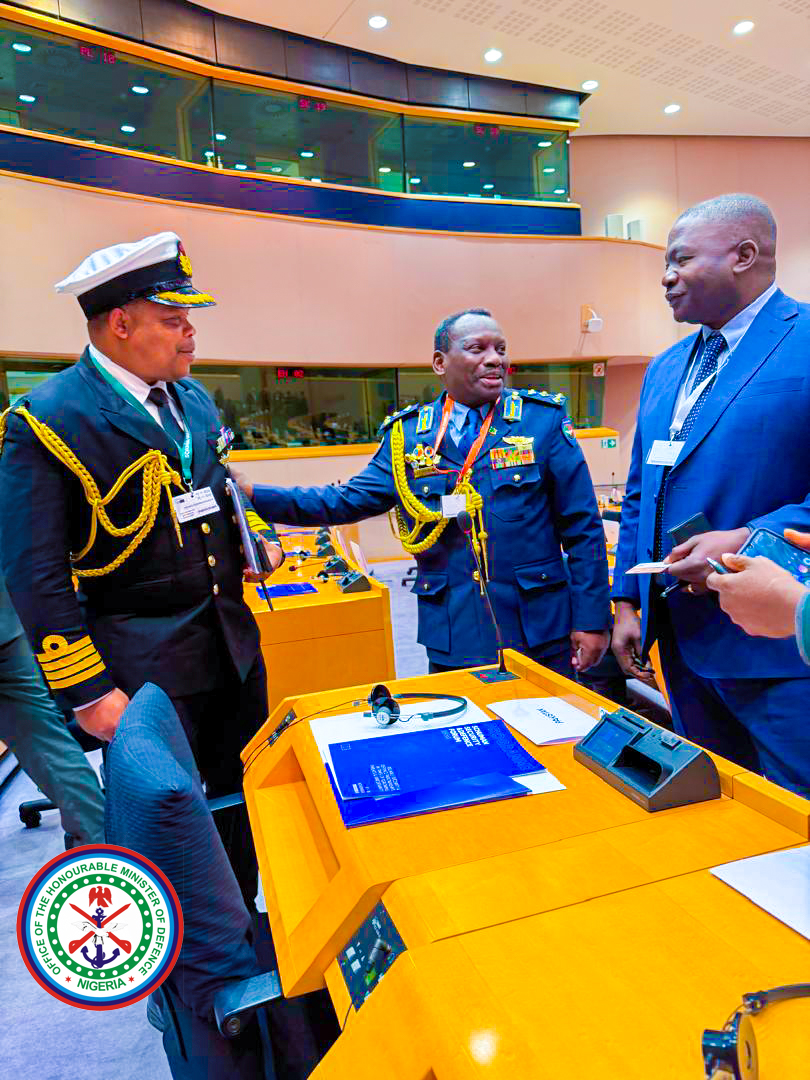
Defence Minister Christopher Musa highlights intelligence sharing, drone technology and financial disruption at Schuman Security and Defence Forum in Brussels.
Nigeria has reaffirmed its commitment to a comprehensive, whole-of-government strategy to combat terrorism, calling for stronger intelligence sharing, technological cooperation and operational partnerships with the European Union (EU) and regional allies.

The Minister of Defence, General Christopher Gwabin Musa (retd.), made this known while representing Nigeria at the third Schuman Security and Defence Forum held at the European Parliament in Brussels, Belgium.
According to a statement issued on November 20, 2026, by Leah Katung-Babatunde, Special Assistant on Media to the Minister, Musa said Nigeria was adopting a coordinated approach to address the complex security challenges posed by terrorism and violent extremism.

He explained that terrorist groups exploit economic vulnerabilities, porous borders, local grievances and transnational organised crime to sustain their activities, making a comprehensive response essential.
Under the leadership of President Bola Ahmed Tinubu, the Federal Government, guided by the National Counter Terrorism Strategy (NACTEST), has expanded its approach beyond military operations to incorporate intelligence gathering, law enforcement, community engagement and socioeconomic interventions.
Nigeria targets emerging terrorist technologies
The minister highlighted the growing threat posed by the misuse of drones, digital communication systems and satellite technologies by terrorist networks.
He said the Armed Forces of Nigeria were strengthening intelligence-led operations through advanced surveillance, unmanned aerial platforms and the application of artificial intelligence to disrupt terrorist capabilities.
Musa also disclosed that troops of Operation Hadin Kai intercepted more than 400 Starlink communication devices allegedly linked to terrorist networks in Nigeria’s North-East in May 2026.
He said Nigeria was also promoting indigenous defence innovation through research and partnerships with private-sector organisations, while seeking closer cooperation with the EU in counter-drone technology, digital forensics and satellite intelligence.
Government targets terrorist financing
The Defence Minister stressed that military action alone would not deliver lasting peace unless the criminal networks financing terrorism were dismantled.
He identified kidnapping for ransom, illegal mining, cattle rustling and illicit arms trafficking as some of the criminal activities sustaining insurgency and insecurity.
According to him, the Nigerian Financial Intelligence Unit (NFIU), the National Counter Terrorism Centre (NCTC) and other security agencies are working together to trace illicit financial flows, prosecute criminal facilitators and strengthen border security.
The initiative, he said, is designed to disrupt the supply chains and financial networks that enable terrorist groups to operate.
Nigeria reiterates commitment to regional security
Musa reaffirmed Nigeria’s commitment to regional and international security cooperation through the Multinational Joint Task Force operating in the Lake Chad Basin, the Economic Community of West African States (ECOWAS), the African Union and international initiatives such as the West Africa Police Information System (WAPIS).
He noted that cooperation among countries and security institutions remained critical to tackling the cross-border nature of terrorism and organised crime.
The minister further maintained that the Nigerian Armed Forces remained committed to national laws and international humanitarian law, with emphasis on civilian protection, due process in the prosecution of suspects, and the rehabilitation and reintegration of eligible former combatants.
He cited Operation Safe Corridor as an example of Nigeria’s efforts to support the rehabilitation and reintegration of eligible former combatants.
The Schuman Security and Defence Forum provides a platform for high-level discussions on international peace, security and defence among defence ministers from partner countries and EU member states, representatives of international organisations and leading think tanks.
Nigeria’s participation underscores its efforts to strengthen international partnerships and promote a coordinated response to terrorism, violent extremism and other transnational security threats.



NAN Staff appointed Media Director, Ashaka Carnival Group
Mr Emmanuel Mogbede, an Assistant Editor in Chief of the News Agency of Nigeria (NAN)has been appointed as the Director...


Ayra Starr joins 2027 Coachella lineup alongside Dua Lipa, SZA, Madonna
Nigerian singer Ayra Starr has been named among the artistes scheduled to perform at the 2027 edition of the Coachella...


Blessing CEO admits faking cancer diagnosis to raise donations
Social media personality says financial pressure prompted fundraising stunt Social media personality Blessing Okoro, popularly known as Blessing CEO, has...

Nigeria seeks stronger security cooperation with EU to combat terrorism

Italy v France – UEFA Nations League 2026/27: Zidane rules out revenge

AIA Hong Kong & Macau Announces “Omni Healthcare Circle” to Advance Quality and Affordable Healthcare in Hong Kong

Yahaya Bello and Edward David Onoja’s sad legacy of a brutal administration (2016–2023)
Technology at Work, Heritage for All: The “Chinese Approach” to Safeguarding the Leshan Giant Buddha

APC ‘rented crowds’ to fill ’empty seats’ at Kaduna rally – Opposition ADC claims

Harry Kane of Bayern Munich is winner of 2026 Ballon d’Or after display – Arsenal Midfielder Declan Rice deckares

UbuntuCare Africa introduces ‘Gift Health’ to Nigerians at OffChart NXT 2026

BREAKING. Imo West Senatorial District: Uzodinma loses as Court orders publication of Okorocha as candidate

Kogi: Suspected kidnappers informants arrested after robbery operation

BREAKING: Suspected ‘Abu Odoma boys’ set Maikano Diesel Generator donated by Muri ablaze overnight at Idah LG

Research funding: Union demands 5% tax from 14 MDAs

2023: Senator Marafa, Ex-governor Yari defect to PDP
