
News
Money Laundering: Abubakar Malami in Court, pleads not guilty to charges

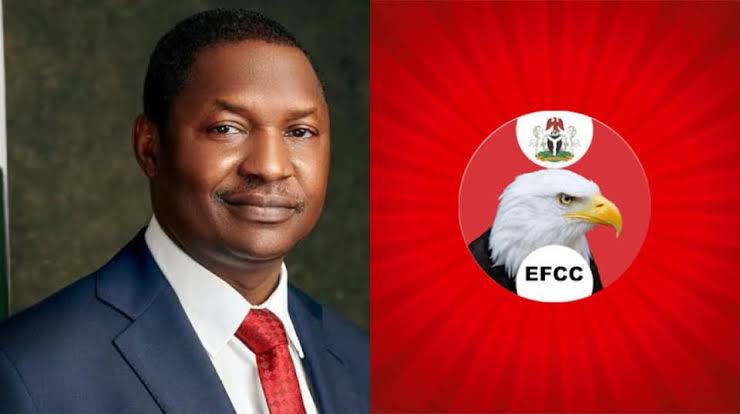
The ex-Attorney General and Minister of Justice in the former President Muhammadu Buhari administration, Abubakar Malami has appeared in Court on Tuesday, and pleaded not guilty to allegations against him by the Economic and Financial Crimes Commission, EFCC.
Malami appeared before the Justice Emeka Nwite of the Federal High Court, Abuja alongside his son, Abubakar Abdulaziz Malami, and one, Hajia Bashir Asabe to be arraigned in Court.

The 16-count charge was read to their hearing and they pleaded not guilty to all the charges.
The charge sheet marked FHC/ABJ/CR/700/2025 accused the trio of money laundering and unlawful acquisition of properties valued over N8.7 billion.

The defendants allegedly conspire, conseal, disguise, retain and indirectly acquire proceeds of unlawful activities through bank accounts, corporate fronts and real estate transactions spanning nearly a decade.
The alleged offences were said to have been committed between 2015 and 2025, largely in Abuja, while Malami was serving as the nation’s chief law officer.
According to the charge filed by the EFCC and signed by a prosecution team led by Chief J.S. Okutepa, SAN, Malami and his son allegedly used Metropolitan Auto Tech Limited to conceal the unlawful origin of N1.014 billion kept in a Sterling Bank account between July 2022 and June 2025.
The commission further alleged that another N600.01 million was concealed in the same account between September 2020 and February 2021.
The EFCC also accused the defendants of retaining N600 million as cash collateral for a N500 million loan granted by Sterling Bank Plc to Rayhaan Hotels Ltd, despite allegedly knowing that the funds represented proceeds of unlawful activity.
In another count, the anti-graft agency alleged that between November 2022 and October 2025, the defendants indirectly took control of N1.36 billion paid through the Union Bank account of Meethaq Hotels Ltd, which they allegedly knew to be illicit funds.
The EFCC claimed that the alleged actions violate the provisions of the Money Laundering (Prohibition) Act, 2011 (as amended) and the Money Laundering (Prevention and Prohibition) Act, 2022.
The anti-graft agency has listed a range of witnesses, including investigators, bank officials, bureau de change operators, and company representatives, to support its case.










Dolly Parton, country star, actor and philanthropist, dies aged 80
Songwriter of I Will Always Love You, Jolene and 9 to 5 also invested millions in child literacy, Covid-19 vaccine...


Russian stadium says it won’t host Kanye West gigs
West’s 2026 tour has been hit by cancellations amid backlash over his history of antisemitic comments The Russian stadium that...


2Baba, Annie reconnect on Instagram months after they parted ways
The Idoma born music maestro, Innocent Idibia popularly called 2Baba has reconnected with his estranged wife, Annie on Instagram to...
Kihívásokkal teli út a chickenroad játékban, ahol a siker a stratégiai tervezéstől függ
Szórakozás garantált a thechickenroad-hungary.com játékban, ahol a tyúk biztonságos átkelése a cél

Macao Union Medical Center Deepens Healthcare Cooperation with Southeast Asia, Leverages Advantages in Critical and Complex Disease Treatment to Expand International Space for “ Healthcare + Tourism” Development

President Of Myanmar Visits VinFast Manufacturing Complex In Hai Phong
Intricate strategies unlock divine wins with gates of olympus and expert gameplay

There’s no recruitment in the name of the Proposed Nigeria Coast Guard

The Illusion of Power: When Institutions forget whom they serve

Veryblackman arrested for allegedly threatening life of comedian DeeOne
2Baba, Annie reconnect on Instagram months after they parted ways

ADC attacks Tinubu, says he’s ‘run out of ideas’

BREAKING: Suspected ‘Abu Odoma boys’ set Maikano Diesel Generator donated by Muri ablaze overnight at Idah LG

Research funding: Union demands 5% tax from 14 MDAs

2023: Senator Marafa, Ex-governor Yari defect to PDP
