
Politics
2027: Makinde confirms coalition talks with Atiku, Peter Obi to challenge Tinubu

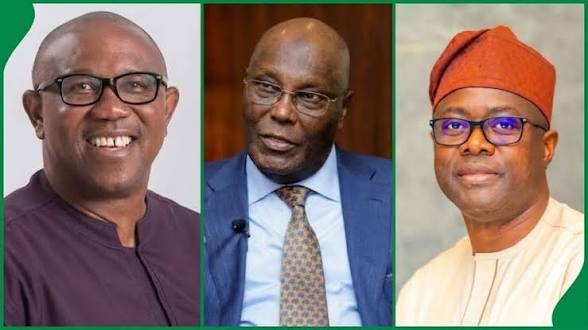
Oyo State Governor, Seyi Makinde, has confirmed that opposition politicians are engaged in discussions to explore the possibility of forming a coalition ahead of the 2027 presidential election to challenge President Bola Ahmed Tinubu and the ruling All Progressives Congress (APC).
Makinde said he was willing to work with former Vice President Atiku Abubakar of the African Democratic Congress (ADC) and Peter Obi of the National Democratic Congress (NDC), stressing that political differences should not prevent opposition leaders from pursuing a common goal.

The governor, who is identified in the report as the presidential candidate of the All Progressives Movement (APM), disclosed this during an interview on ARISE Television anchored by Joy Okpe.
He said discussions among opposition figures were ongoing and had moved beyond preliminary considerations about whether he would be willing to work with Atiku or Obi.
“We’re still discussing,” Makinde said.
He added, “Not only that I’m open, we’re actively discussing this.”

However, the governor did not endorse either Atiku or Obi as the potential presidential candidate of a proposed opposition coalition. Instead, he argued that any decision on who should lead such an alliance must be based on objective assessments rather than personal relationships, political affiliations or emotional considerations.
According to Makinde, opposition leaders must consider candidates’ capacity, political records, policy proposals and public acceptance before reaching an agreement.
“To arrive at a decision, you need data,” he said.
The governor explained that the candidates’ manifestos, previous performances in public office and public opinion should guide the negotiations.
“We just won’t say, ‘Oh, okay,’ take emotional decision and say, ‘Oh, it’s you.’ We have manifestos now, we have certain things in that manifesto,” he said.
“We will sit down, we have maybe historical performance. We also have the sentiment of the people. All of those things will come together and arrive at a decision.”
Makinde maintained that political competition does not rule out cooperation, noting that individuals and organisations with competing interests can still work together when they identify a common objective.
Drawing from his experience in the oil and gas industry, he said companies operating in the same sector sometimes collaborate despite competing for business and opportunities.
He used the example to illustrate the possible outcomes of the opposition negotiations, explaining that some politicians could become allies while others might occupy different positions depending on the eventual arrangement.
“Depending on what we see between now and the election time, we may be rivals, we may be collaborators, we may be — one may be the client of the other,” he said.
During the interview, Okpe asked whether Makinde was prepared to cooperate with other opposition leaders as part of his campaign to reset Nigeria.
The governor answered in the affirmative, insisting that his willingness to collaborate was not limited to any particular politician or political party.
“To reset Nigeria, yes,” he said.
When asked whether he would support Atiku if consultations and available evidence showed that the former vice president was the most suitable candidate to lead the opposition into the 2027 presidential election, Makinde replied, “Yes.”
He further declared, “I’m willing to work with any Nigerian.”
Makinde also referenced Nigeria’s political history to argue that opposition leaders must look beyond regional popularity when determining who can win a presidential election nationally.
He cited the 1999 presidential election, in which Olu Falae, who enjoyed considerable support in the South-West, lost to Olusegun Obasanjo, who went on to become president.
The governor said opposition politicians must first agree on the best political strategy before proceeding to negotiate an alliance.
“Our biggest challenge is, first, to agree on what is the best course of action, and then seek an alliance,” he said.
He also pointed to South Africa’s political experience, where rival political interests have entered negotiations and cooperation arrangements when circumstances demanded broader political understanding.
According to Makinde, Nigeria’s opposition leaders must demonstrate similar flexibility and avoid allowing individual ambitions to undermine the prospect of presenting a united front.
He stressed that the negotiations should not be driven by personal interests or become a platform for politicians to bargain for positions.
Instead, he said, the discussions should focus on finding a common political direction capable of addressing Nigeria’s challenges.
“That negotiation will not be anything personal,” Makinde said.
“That negotiation will be the deal for Nigeria, by Nigeria.”
The proposed coalition talks come as political parties and opposition figures begin positioning themselves ahead of the 2027 general election. Whether the discussions will produce a common presidential candidate remains uncertain, with Makinde insisting that any eventual decision must be guided by evidence, performance and the broader interests of Nigerians.









Nollywood Actress, Bimbo speaks about Funke Akindele’s ugly past before her shining time
A colleague of Nollywood actress, Funke Akindele has spoken about Funke’s struggles in the past before she shot to limelight....


Mista Xto marks 30 years anniversary in music industry
Nigerian musician and entertainer, Mista Xto, is set to mark 30 years in the entertainment industry with a special anniversary...


Music star John Anderson dies at 71
Country music singer John Anderson, known for hits including Swingin’, Straight Tequila Night and Seminole Wind, has died at the...

2027: Makinde confirms coalition talks with Atiku, Peter Obi to challenge Tinubu

CALL-E Lets AI Agents in ChatGPT, Muse and OpenClaw Make Real Phone Calls on Their Users’ Behalf

Lagos APC denies sponsoring disruption of NDC event, says it was in Epe

2027: INEC may drop Atiku’s candidacy if he fails to overturn Court Judgment — Amupitan
Vesalius Longevity Labs Appoints Harvey Spevak as Chairman to Accelerate Global Growth and Brand Development

Court sentences christian mother to 14 years imprisonment for sharing faith with muslim woman

‘Suspend frequent travels in pursuit of money and attend to me’, heavily pregnant Jarvis to Peller

Nigeria meets OPEC quota for 5th consecutive month as daily peak hits1.84m barrels in September

Wike inducted into Idoma Hall of Fame, calls for shift in ‘politics of entitlement ‘

Ebola: Tinubu gov’t tells Nigerians not to panic

BREAKING: Suspected ‘Abu Odoma boys’ set Maikano Diesel Generator donated by Muri ablaze overnight at Idah LG

Research funding: Union demands 5% tax from 14 MDAs

2023: Senator Marafa, Ex-governor Yari defect to PDP
