
News
2027: 54 officials to be punished over Voter Register irregularities – Prof. Amupitan


..Removes 1.6 million invalid voter records, sets December 15 for final register publication
The Independent National Electoral Commission (INEC) has identified 54 registration personnel across 10 states for possible disciplinary action, including prosecution, over irregularities uncovered in the national voters register ahead of the 2027 general elections.

INEC Chairman, Professor Joash Amupitan, SAN, disclosed this on Monday, November 9, 2026, while briefing journalists on the outcome of the review of the Preliminary Register of Voters displayed nationwide between October 9 and 15.
Amupitan also announced that the commission had removed 1,609,553 records from the register following a nationwide cleaning exercise aimed at strengthening the credibility and accuracy of the electoral database.

According to him, the deleted records comprised 1,608,660 confirmed invalid registrations and 873 records belonging to verified deceased voters.
He explained that the exercise followed complaints, claims and objections from Nigerians concerning suspected multiple registrations, manipulated photographs, unusual names and registration patterns, as well as the inclusion of deceased persons in the preliminary register.
INEC Uncovers Registration Irregularities.
Providing details of the review, the INEC chairman said the commission received 11,088,238 registration records from the three phases of the 2025/2026 Continuous Voter Registration (CVR) exercise.
He said the commission’s Automated Biometric Identification System (ABIS) initially flagged 1,545,052 records for further examination.
However, Amupitan clarified that being flagged by the automated system did not automatically render a registration invalid, as each case was subjected to further examination and authorised adjudication before a final decision was taken.
He disclosed that 1,277,052 registrations had been confirmed invalid and excluded before the publication of the Preliminary Register of Voters.
Following the nationwide public display of the register and subsequent complaints, another 268,000 cases underwent adjudication. Of these, 217,722 were confirmed invalid and removed, while 50,278 were cleared and retained.
The commission subsequently identified an additional 113,886 invalid registrations through further screening, bringing the total number of invalid records removed following the public objections and review to 331,608.
Combined with the 1,277,052 registrations excluded earlier, the total number of invalid registrations removed stood at 1,608,660.
The removal of 873 records belonging to verified deceased voters brought the overall number of deleted records to 1,609,553.
54 Registration Personnel Face Investigation.
On the circumstances surrounding the irregularities, Amupitan said the commission’s technical assessment revealed suspected multiple registrations, substituted photographs and irregularities linked to registration transactions.
He alleged that some registration personnel deliberately circumvented established procedures and abused provisions designed to accommodate exceptional registration circumstances, including arrangements for persons with disabilities.
According to him, the affected records have been identified and subjected to appropriate review and remediation, while the personnel involved have been identified for further administrative investigation.
The chairman said the 54 officials identified across 10 states could face disciplinary measures, including prosecution, depending on the outcome of the investigations.
He added that INEC was strengthening its registration controls through improved biometric capture, authentication and verification safeguards to prevent a recurrence of the irregularities.
Historical Records Also Under Scrutiny
Amupitan cautioned that the cleaning exercise covering the 2025/2026 CVR alone would not resolve all concerns surrounding the integrity of the national voters register.
He explained that several suspected duplications originated from historical registration exercises conducted between 2011 and 2023.
According to him, most of the duplicated names and photographs circulated on social media during the controversy related to the historical register rather than the latest registration exercise.
The chairman disclosed that, at its meeting on Monday, November 9, 2026, the commission resolved to address the historical irregularities.
He said INEC had directed that cases previously flagged through public complaints, alongside obvious irregularities identified in the register, should be removed after proper verification.
The commission had earlier announced plans to conduct a nationwide voter revalidation exercise in February 2026 to improve the accuracy and reliability of the register, particularly records captured using older registration technologies.
However, the exercise was postponed following concerns raised by stakeholders about its proximity to the 2027 general elections and the possibility of disenfranchising eligible voters.
Amupitan stressed that the postponement did not suspend existing mechanisms for safeguarding the register, including biometric screening, adjudication and statutory claims and objections.
INEC Explains Missing Names in Voters Register
Addressing complaints from some Nigerians who could not find their names in the preliminary register, the INEC chairman said investigations showed that most of the affected individuals had registered between 2011 and 2023 but subsequently registered again instead of transferring their voter registration to their new locations.
He explained that the subsequent registrations were invalidated by the biometric screening system, while their original registrations remained valid in their previous locations.
He therefore advised affected voters to check the register at their former locations to confirm the status of their registration.
The commission reiterated its commitment to removing invalid entries without wrongly excluding eligible voters from the electoral process.
PVC Distribution Continues Nationwide
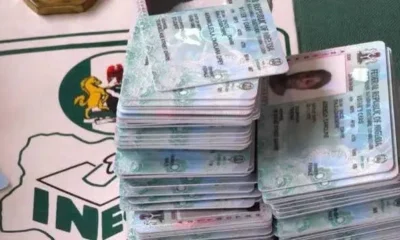
Amupitan also announced that the distribution of Permanent Voter Cards (PVCs) from the first and second phases of the registration exercise, including transferred cards, was ongoing across various local government areas.
He said some PVCs produced under the third and final phase were being delivered and would be dispatched to states from the following week.
According to him, distribution would return to Registration Areas nationwide from December 1, 2026.
The chairman appealed to Nigerians who participated in the third phase of the registration exercise to exercise patience, explaining that the production of their cards was being handled outside the country.
BVAS to Strengthen Electoral Safeguards
On preparations for the 2027 general elections, Amupitan maintained that the Bimodal Voter Accreditation System (BVAS), alongside established election-day procedures, would provide additional safeguards against multiple accreditation and voting.
He explained that voters would be required to appear physically at their designated polling units for biometric authentication through fingerprints or facial recognition.
According to him, the system is designed to prevent multiple accreditation and strengthen the integrity of the voting process.
Amupitan further announced that the final register of voters would be published on December 15, 2026, following reconciliation, quality assurance and other publication checks.
He assured Nigerians that INEC would continue to provide verifiable information about the cleaning exercise while protecting personal data and preserving the integrity of ongoing investigations.
Clarify the voter-record arithmetic. Tighten the historical-register timeline Reduce repetition around record removals.












Nollywood Actress, Bimbo speaks about Funke Akindele’s ugly past before her shining time
A colleague of Nollywood actress, Funke Akindele has spoken about Funke’s struggles in the past before she shot to limelight....


Mista Xto marks 30 years anniversary in music industry
Nigerian musician and entertainer, Mista Xto, is set to mark 30 years in the entertainment industry with a special anniversary...


Music star John Anderson dies at 71
Country music singer John Anderson, known for hits including Swingin’, Straight Tequila Night and Seminole Wind, has died at the...

Eisenkot, Netanyahu meet for two-hour security briefing amid tensions over potential Iran strikes

NLC issues Delta govt two-week ultimatum over alleged harassment, ban on MOUN

Emefiele created system to extort Forex seekers, EFCC tells Court

Namadi, Tompolo to Jigawa voters: Give your 2m votes to Tinubu, 31 campaign vehicles unveiled

I was once a “millionaire”, became a “billionaire farmer” 20 years ago – Terry Waya

Court sentences christian mother to 14 years imprisonment for sharing faith with muslim woman

‘Suspend frequent travels in pursuit of money and attend to me’, heavily pregnant Jarvis to Peller

Nigeria meets OPEC quota for 5th consecutive month as daily peak hits1.84m barrels in September

Wike inducted into Idoma Hall of Fame, calls for shift in ‘politics of entitlement ‘

Ebola: Tinubu gov’t tells Nigerians not to panic

BREAKING: Suspected ‘Abu Odoma boys’ set Maikano Diesel Generator donated by Muri ablaze overnight at Idah LG

Research funding: Union demands 5% tax from 14 MDAs

2023: Senator Marafa, Ex-governor Yari defect to PDP
