
Politics
Tinubu targets $1trn Nigerian economy by 2030 – APC Chairman

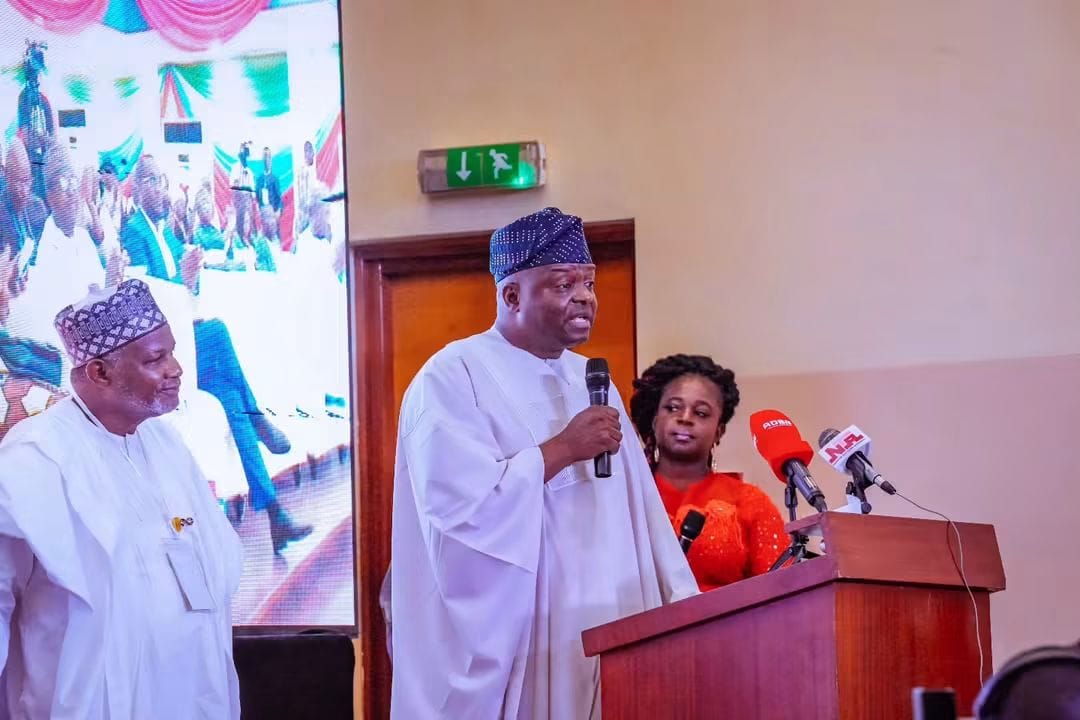
President Bola Ahmed Tinubu is targeting a $1 trillion Nigerian economy by 2030, with the Federal Government banking on ongoing economic reforms, infrastructure expansion, human-capital development and increased productive capacity to achieve the ambitious goal.
National Chairman of the All Progressives Congress (APC), Prof. Nentawe Yilwatda, disclosed this on Tuesday while representing President Tinubu as Special Guest of Honour at the second edition of the Asiwaju Scorecard Series/Asiwaju Policy Roundtable, organised by the APC Professional Forum in Abuja.

Yilwatda said the administration inherited an economy weighed down by fuel subsidy distortions, multiple foreign-exchange windows, weak revenue mobilisation, foreign-exchange shortages, rising debt-service pressures and years of inadequate investment in critical infrastructure.
He said the President consequently took difficult but necessary decisions, particularly the removal of fuel subsidy and the reform of the foreign-exchange market, to place the economy on a more sustainable path.

According to him, recent economic indicators suggest that the reforms are beginning to strengthen the foundation of the economy.
He cited the rise in Nigeria’s gross external reserves to about $52.7 billion by August 2026, growth in consolidated non-oil revenue from approximately N13.63 trillion in 2023 to N16.4 trillion in the first two quarters of 2026, improved merchandise trade performance, real GDP growth of 4.43 per cent in the second quarter of 2026 and a decline in inflation to about 15.4 per cent from its earlier peak.
“These figures do not mean that our economic challenges have disappeared, but they demonstrate that the direction of travel has changed,” he said.
The APC chairman, however, stressed that macroeconomic stability was not the ultimate destination of the Renewed Hope Agenda, but the foundation for improving the living conditions of Nigerians.
“The ultimate test is when stability translates into cheaper food, more jobs, affordable credit, reliable electricity and greater purchasing power for Nigerians,” he said.
Yilwatda said the $1 trillion target should therefore be understood not merely as a numerical ambition, but as a broader development strategy designed to make Nigeria more productive, competitive and attractive to investors.
He said achieving the target would require the country to take advantage of its strategic location, maritime resources, population, natural resources and expanding consumer market.
A major component of the strategy, he said, was the development of an integrated national transportation and economic architecture linking production centres, ports, markets and neighbouring countries.
Yilwatda proposed an integrated five-port maritime and logistics corridor linking major deep-sea ports in Lagos, Ondo, Akwa Ibom, Port Harcourt and Calabar through modern rail and road infrastructure.
He said the Lagos-Calabar Coastal Super Highway could provide a major coastal road spine, while rail and road corridors would connect the maritime gateways to Nigeria’s interior and, ultimately, markets across West, Central and North Africa.
According to him, the Western Corridor would link the maritime gateways to the interior through the Lagos-Abuja-Kaduna-Kano rail corridor, complemented by the Sokoto-Badagry Super Highway.
The Eastern Corridor, he added, would connect eastern maritime gateways through the Port Harcourt-Abuja-Kaduna-Kano rail corridor and the proposed Calabar-Maiduguri Trans-Sahara Super Highway.
Yilwatda said the network could eventually connect Nigeria’s ports to landlocked markets in Niger, Chad, Burkina Faso, Sudan and the Central African Republic.
“This is how Nigeria can move beyond being simply a coastal trading nation to becoming the maritime gateway and logistics hub of West and Central Africa, capturing a much larger share of the continent’s trade, logistics, manufacturing and distribution value chain,” he said.
He described the proposed infrastructure network as more than a transportation project, saying, “It is a trade architecture.”
According to him, industrial parks, export-processing zones, logistics parks, agro-processing clusters and manufacturing centres should be developed along the corridors to ensure that infrastructure translates directly into economic activity and jobs.
“Where rail reaches an agricultural region, processing industries should follow. Where it reaches mineral resources, processing and manufacturing should follow.
Where dry ports are established, logistics and distribution businesses should develop around them. This is how infrastructure becomes an engine of economic growth,” he said.
The APC chairman also highlighted the strategic importance of extending rail connectivity towards Maradi and the wider Sahel, saying improved regional connectivity would open new markets for Nigerian businesses and enable more trade-related activities to remain within the country.
“If you are a businessman in Nigeria, the rail to Maradi will ensure that you can trade with all the neighbouring countries,” he said.
He urged northern governors to view the emerging transport corridors as instruments of economic transformation rather than simply road and rail projects.
Yilwatda also identified reliable and affordable energy as critical to achieving industrial transformation, noting that Nigeria’s abundant natural gas resources could power a new phase of industrialisation.
He specifically cited the Ajaokuta-Kaduna-Kano (AKK) gas pipeline, saying its importance extended beyond the transportation of gas to supporting electricity generation, fertiliser production, manufacturing, transportation and household energy supply.
He called for deliberate policies to encourage fertiliser plants, manufacturing facilities and other energy-intensive industries to locate along major infrastructure corridors.
On human capital, Yilwatda highlighted investments in education, skills development and access to credit as critical components of the administration’s economic strategy.
He said the Nigerian Education Loan Fund (NELFUND) was established to ensure that financial constraints did not prevent qualified young Nigerians from accessing higher education.
Drawing from his experience as a university lecturer, he said he had witnessed brilliant students abandon their education because their families could not afford school fees.
“Even if you don’t like President Tinubu, your children can access the fund and access higher education,” he said.
He also cited digital skills programmes and credit initiatives for small and medium-scale enterprises as efforts to increase the productive capacity of Nigerians, create businesses and generate employment.
Yilwatda said the administration’s economic agenda also covered healthcare and solid minerals, citing investments in cancer treatment infrastructure and maternal healthcare.
He said the solid minerals sector offered another major opportunity for economic diversification, investment and job creation, stressing the need for Nigeria to process more of its raw materials domestically rather than exporting them in their unprocessed form.
Earlier, Chairman of the APC Professional Forum, Alhaji Isa Yuguda, described the Asiwaju Scorecard Series as a platform for party members, policymakers and public officials to explain their contributions to the Renewed Hope Agenda.
Yuguda urged APC members to use the platform to document and communicate the administration’s achievements across various sectors.
He also defended the removal of fuel subsidy, describing it as one of the most consequential decisions of the Tinubu administration.
According to him, although the policy created immediate difficulties, the former subsidy regime was characterised by leakages, opacity and abuse, with resources that could have been deployed for national development being lost.
He said the removal of the subsidy had expanded the fiscal capacity of federal and state governments and created greater room for investment in infrastructure, education and other development priorities.
Yuguda warned against attempts to return to the old subsidy regime as the country approaches the 2027 general elections, urging Nigerians to scrutinise the sustainability and credibility of political parties’ economic proposals.
He cautioned that any attempt to reverse the reform could return the country to the fiscal and governance challenges associated with the previous subsidy regime.



NAN Staff appointed Media Director, Ashaka Carnival Group
Mr Emmanuel Mogbede, an Assistant Editor in Chief of the News Agency of Nigeria (NAN)has been appointed as the Director...


Ayra Starr joins 2027 Coachella lineup alongside Dua Lipa, SZA, Madonna
Nigerian singer Ayra Starr has been named among the artistes scheduled to perform at the 2027 edition of the Coachella...


Blessing CEO admits faking cancer diagnosis to raise donations
Social media personality says financial pressure prompted fundraising stunt Social media personality Blessing Okoro, popularly known as Blessing CEO, has...

Nigeria seeks stronger security cooperation with EU to combat terrorism

Italy v France – UEFA Nations League 2026/27: Zidane rules out revenge

AIA Hong Kong & Macau Announces “Omni Healthcare Circle” to Advance Quality and Affordable Healthcare in Hong Kong

Yahaya Bello and Edward David Onoja’s sad legacy of a brutal administration (2016–2023)
Technology at Work, Heritage for All: The “Chinese Approach” to Safeguarding the Leshan Giant Buddha

APC ‘rented crowds’ to fill ’empty seats’ at Kaduna rally – Opposition ADC claims

Harry Kane of Bayern Munich is winner of 2026 Ballon d’Or after display – Arsenal Midfielder Declan Rice deckares

UbuntuCare Africa introduces ‘Gift Health’ to Nigerians at OffChart NXT 2026

BREAKING. Imo West Senatorial District: Uzodinma loses as Court orders publication of Okorocha as candidate

Kogi: Suspected kidnappers informants arrested after robbery operation

BREAKING: Suspected ‘Abu Odoma boys’ set Maikano Diesel Generator donated by Muri ablaze overnight at Idah LG

Research funding: Union demands 5% tax from 14 MDAs

2023: Senator Marafa, Ex-governor Yari defect to PDP
