
News
Centre LSD to mobilise 1,000 male leaders for gender advocacy

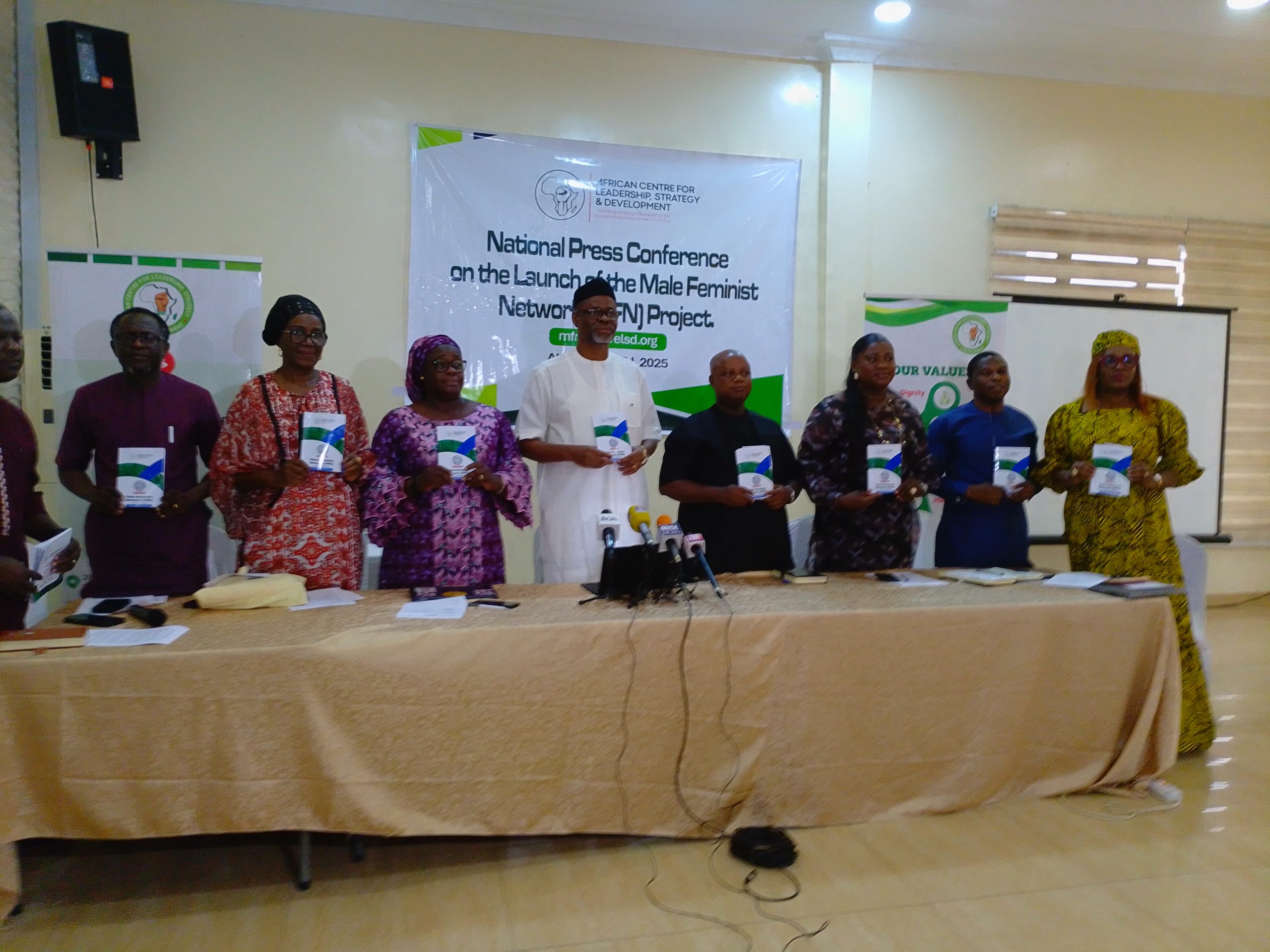
The African Centre for Leadership, Strategy & Development (Centre LSD) has unveiled plans to train and mobilise at least 1,000 male leaders and grassroots influencers across Nigeria in gender advocacy and feminist principles.
Founding Executive Director of Centre LSD, Dr. Otive Igbuzor, made the announcement during the launch of the Male Feminist Network (MFN) project on Friday in Abuja.

The Centre explained that men, who hold influence in homes, workplaces, religious institutions, politics, and traditional structures, can drive transformative change by aligning their influence with feminist values.
They explained that the initiative recognises that women are historically marginalised and need the active support of men to dismantle systemic barriers. This, according to them, is a key step toward ending Gender-Based Violence (GBV) and promoting gender equality.

“Over the next two years, through the support of the Ford Foundation, we will work with zonal partners to train and mobilise at least 1,000 male leaders and grassroots influencers in gender advocacy and feminist principles.
“We will build a functional, inclusive, and visible national network of male feminists.
“Engage traditional, religious, and cultural leaders to adopt gender-sensitive practices. Amplify public awareness through the strategic use of traditional and digital media to challenge toxic masculinity and promote inclusive gender narratives,” Dr. Igbuzor stressed.
Citing data from the National Demographic and Health Survey and the National Bureau of Statistics, the Centre revealed that over 35% of Nigerian women have experienced physical violence, while millions more suffer emotional, sexual, and economic abuse.
“One in ten women lives in poverty; women are less likely than men to have access to social protection. Women are more food insecure than men and suffer more from lack of water and sanitation.
“In Nigeria, the situation is more precarious. Men gained voting rights in 1922 through the Clifford Constitution, but women all over Nigeria gained voting rights in 1979 through the 1979 Constitution — a 57-year gap.
“We also know that patriarchal norms, entrenched in our cultural, social, and even legal systems, fuel these injustices. Too often, men are either direct perpetrators of violence or passive bystanders when harmful practices are carried out,” the Centre added.
Centre LSD, however, urged governments at all levels to prioritise funding and policy reforms that institutionalise male engagement in GBV prevention and gender equality promotion.
It also urged the government, donor agencies, and the private sector to collaborate in funding, policy, and workplace initiatives that integrate male allyship into the fight against GBV.
Board Chairperson of Centre LSD, Kyauta Agmadalo Giwa, stressed that the MFN is about reshaping societal narratives.
“This project is rooted in a simple but radical idea: that men must be allies, advocates, and active participants in the movement for gender justice. Feminism is not just a women’s issue — it is a human issue,” she said.







Music star John Anderson dies at 71
Country music singer John Anderson, known for hits including Swingin’, Straight Tequila Night and Seminole Wind, has died at the...


‘Suspend frequent travels in pursuit of money and attend to me’, heavily pregnant Jarvis to Peller
“Money isn’t everything. You are chasing money more than the baby that is coming and my own mental health. Your...


BB Bucks, kisses, fake eviction: How Temi Nkem won BBNaija Season II
From BB Bucks drama and a memorable custard episode to a controversial kiss with Tram, a fake eviction and a...

XTransfer Returns to Hong Kong FinTech Week and Singapore FinTech Festival for Third Consecutive Year

Israeli Election: Netanyahu leads, but no clear winner

The Cascade of Sleep Deprivation: Bupa’s Health or Hype Explores the Real-World Impact of Curtailing Sleep

Feeding Malaysia: Sabak Bernam’s Growing Role in National Food Security

Troops recover 2 AK47 refles after foiling armed attack in Benue

22-year Nigerian model moves beyond Lagos streets into global scene

PC-NCG calls for immediate cessation of unauthorized activities in the name of proposed Nigerian Coast Guard

Security: Combined security agents crush kidnappers in Kogi East, recovers dangerous weapons
BB Bucks, kisses, fake eviction: How Temi Nkem won BBNaija Season II

BREAKING: NAF reveals identity of pilot, names of 25 dead soldiers on crashed aircraft

BREAKING: Suspected ‘Abu Odoma boys’ set Maikano Diesel Generator donated by Muri ablaze overnight at Idah LG

Research funding: Union demands 5% tax from 14 MDAs

2023: Senator Marafa, Ex-governor Yari defect to PDP
