
News
FG moves against inflated public contracts

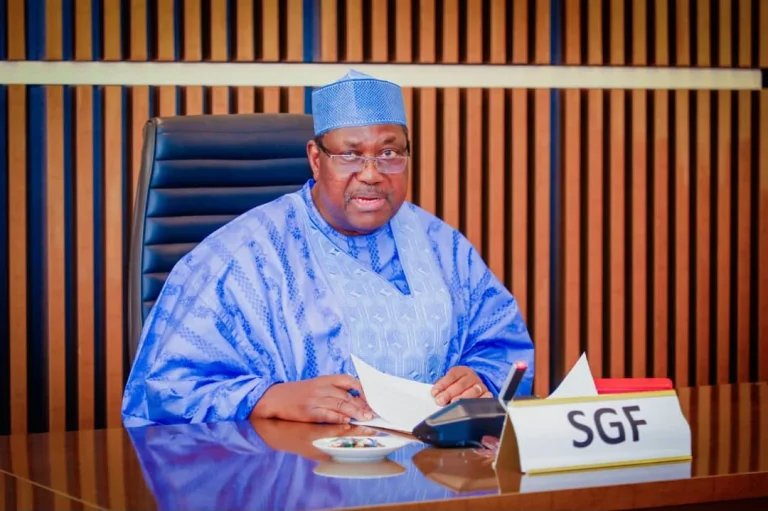
The Federal Government of Nigeria has declared its move to tackle inflated public contracts and procurement violations, warning that any executive of public agency found culpable would face the consequences.
The development followed the notice of inflated public contracts which exceed approved price thresholds, and restricted competition through exclusive arrangements for contractors that undermine regulatory oversight.


This was contained in a circular by the the Secretary to the Government of the Federation, Senator George Akume, directing accounting officers of Federal Government-owned agencies to immediately comply with Public Procurement Act 2020 to avoid sanctions.
The circular obtained on Sunday in Abuja
was addressed to ministers, permanent secretaries, heads of government agencies and parastatals, among other senior public officials.

He pointed out that award of contracts without recognition of the Public Procurement Act as was the manner of some heads of government agencies would henceforth be flagged down with a sanction.
Akume noted that the practice had resulted in inflated contract sums, restricted competition and inadequate regulatory oversight, warning that the government would no longer tolerate such breaches.
He emphasised on all government agencies, including Councils to observe the Public Procurement Act to the latter, by liaising with the Bureau of Public Procurement for guidance.
The directive places responsibility for procurement compliance on accounting officers and requires immediate circulation of the circular among them for strict implementation.
The circular stated, “It has come to the attention of the Federal Government that despite the provisions of Section 15 of the Public Procurement Act, 2007, as amended by the Finance Act, 2020, several Federal Government Owned Enterprises and Corporations continue to procure and award contracts without recourse to the provisions of the Public Procurement Act, 2007.”
“This practice has resulted in contract sums that are above established pricing benchmarks, captive markets for exclusive contractors, significant departure from approved guidelines and absence of critical regulatory oversight, amongst other lapses.”
“This non-compliance is unacceptable and will no longer be tolerated,” he said.











Nollywood Actress, Bimbo speaks about Funke Akindele’s ugly past before her shining time
A colleague of Nollywood actress, Funke Akindele has spoken about Funke’s struggles in the past before she shot to limelight....


Mista Xto marks 30 years anniversary in music industry
Nigerian musician and entertainer, Mista Xto, is set to mark 30 years in the entertainment industry with a special anniversary...


Music star John Anderson dies at 71
Country music singer John Anderson, known for hits including Swingin’, Straight Tequila Night and Seminole Wind, has died at the...

Hackers turn Europe’s fridges into weapons as Cyber War hits supermarkets and blood banks

FCT Minister prepares to receive President Bola Tinubu in Rivers

Ningbo Consensus on Collaborative Development released at 2026 Global Mayors Dialogue · Ningbo

ZTE Showcases at Hong Kong FinTech Week 2026: Architecting a Digital Foundation for the Era of Agentic Finance with “Zero Failure, Trust, Optimal TCO, and Open Ecosystem”
WIC 2026 (Plenary 1) 5th November: Divine Enlargement and Fulfilment

Security: Combined security agents crush kidnappers in Kogi East, recovers dangerous weapons

Court sentences christian mother to 14 years imprisonment for sharing faith with muslim woman

Shareholders commend Fidelity Bank’s strong performance

Federal University of Medical Lab, science and Technology Bill: A Win for Plateau State, says Indigenous Staff

2027: APC sharing N50m-N2bn to opposition candidates to step down from election in Abuja hotel – Buba Galadima

BREAKING: Suspected ‘Abu Odoma boys’ set Maikano Diesel Generator donated by Muri ablaze overnight at Idah LG

Research funding: Union demands 5% tax from 14 MDAs

2023: Senator Marafa, Ex-governor Yari defect to PDP
