
Foreign
Russia’s Putin meets Trump in Alaska for high stakes summit on Ukraine war

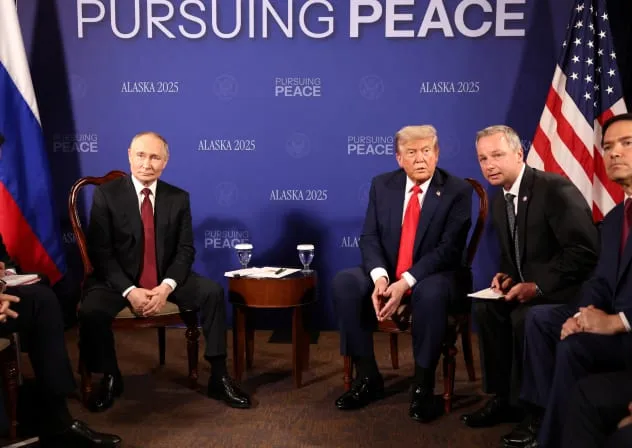
Both the US and Russian presidents are seeking wins from their first face-to-face talks since Trump returned to the White House.
Russian President Vladimir Putin arrived in Alaska for talks with US President Donald Trump on Ukraine. Trump prepared for what he called a “high stakes” summit with Russia’s Vladimir Putin to discuss a ceasefire deal for Ukraine to help end the deadliest war in Europe since World War II.

Putin was accompanied by Foreign Minister Sergei Lavrov and Kremlin aide Yuri Ushakov.
Ukrainian President Volodymyr Zelensky, who was not invited to the talks, and his European allies fear Trump might sell out Ukraine by essentially freezing the conflict and recognizing – if only informally – Russian control over one fifth of Ukraine.

Trump sought to assuage such concerns as he boarded Air Force One, saying he would let Ukraine decide on any possible territorial swaps. “I’m not here to negotiate for Ukraine, I’m here to get them at a table,” he said.
Both the US and Russian presidents, due to meet at a Cold War-era air force base in Alaska’s largest city, are seeking wins from their first face-to-face talks since Trump returned to the White House.
Trump presses for a truce in Ukraine-Russia War
Trump, who casts the war as a “bloodbath” fraught with escalatory risk, is pressing for a truce in the 3-1/2-year-old war that would bolster his credentials as a global peacemaker worthy of the Nobel Peace Prize.
For Putin, the summit is already a big win as he can use it to say that years of Western attempts to isolate Russia have unraveled and that Moscow has retaken its rightful place at the top table of international diplomacy.

US President Donald Trump waves while boarding Air Force One, as he departs for Alaska to meet with Russian President Vladimir Putin from Joint Base Andrews in Maryland, US, August 15, 2025 (credit: REUTERS/KEVIN LAMARQUE)
In a symbolic gesture en route for Alaska, Putin laid flowers on Friday at a memorial in Russia’s Far East commemorating US-Soviet cooperation in World War Two. The Kremlin said Putin would arrive in Alaska at 11 a.m. local time and that Trump would meet the Russian leader at his plane.
Trump, who once said he would end Russia’s war in Ukraine within 24 hours, conceded on Thursday it had proven a tougher task than he had expected. He said that if Friday’s talks went well, quickly arranging a second three-way summit with Zelensky would be even more important than his encounter with Putin.
“It’s time to end the war, and the necessary steps must be taken by Russia. We are counting on America,” Zelensky wrote on the Telegram messaging app on Friday, adding that the Trump-Putin meeting should open the way for a “just peace” and three-way talks with him included.
Of Putin, Trump said on Friday: “He is a smart guy, been doing it for a long time but so have I… We get along, there’s a good respect level on both sides.” He also welcomed Putin’s decision to bring a lot of businesspeople with him to Alaska.
“But they’re not doing business until we get the war settled,” he said, repeating a threat of “economically severe” consequences for Russia if the summit goes badly.
One source acquainted with Kremlin thinking said there were signs that Moscow could be ready to strike a compromise on Ukraine given that Putin understood Russia’s economic vulnerability and costs of continuing the war.
Reuters has previously reported that Putin might be willing to freeze the conflict along the front lines, provided there was a legally binding pledge not to enlarge NATO eastwards and to lift some Western sanctions.
Russia, whose war economy is showing signs of strain, is vulnerable to further US sanctions – and Trump has threatened tariffs on buyers of Russian crude, primarily China and India.
“For Putin, economic problems are secondary to goals, but he understands our vulnerability and costs,” the Russian source said.
On the eve of the summit, Putin held out the prospect of something else he knows Trump wants – a new nuclear arms control agreement to replace the last surviving one, which is due to expire in February next year.
Will US, Russia be able to find common ground in Alaska?
The source familiar with Kremlin thinking said it looked as if the two sides had been able to find some common ground.
“Apparently, some terms will be agreed upon… because Trump cannot be refused, and we are not in a position to refuse (due to sanctions pressure),” said the source, who spoke on condition of anonymity because of the matter’s sensitivity.
Putin has so far voiced stringent conditions for a full ceasefire, but one compromise could be a truce in the air war. Putin has said he is open to a ceasefire but has repeatedly said the issues of verification need to be sorted out first.
Concerns that Trump might concede too much to Putin are not limited to Ukraine and Europe.
“I fear this meeting could once again end with America ceding ground to an autocrat who has spent his career undermining democratic values,” said Mark Warner, the top Democrat on the US Senate intelligence committee.
Zelensky has accused Putin of playing for time to avoid US secondary sanctions and has ruled out formally handing Moscow any territory.
Beyond territory, Ukraine has been clear in talks with Western allies that it needs a security guarantee backed by Washington. It is unclear how that guarantee could work – and what part the US would play in it.
Ukrainians who spoke to Reuters in central Kyiv on Friday were not optimistic about the Alaska summit.
“Nothing good will happen there, because war is war, it will not end. The territories – we’re not going to give anything to anyone,” said Tetiana Harkavenko, a 65-year-old cleaner.
Last week, US Special Envoy to the Middle East Steve Witkoff met with Putin in Moscow. While both sides said that the talks went positively, reports emerged that European officials were frustrated and confused by Witkoff’s restating of the events.
The Wall Street Journal reported last week after Witkoff’s meeting, Trump administration officials told European officials that Russia would be willing to freeze the conflict along the front lines in Zaporizhzhia and Kherson. Russia and Ukraine would then negotiate land swaps; Moscow was aiming to gain control of the two regions, but officials who spoke to the WSJ stated they were unclear as to which regions Ukraine could gain.
However, in later calls, Witkoff later walked these statements back. Two European officials familiar with the calls told the WSJ that Russia wanted a two-phase ceasefire: In the first phase, troops would withdraw from Donetsk and freeze the frontlines; in the second, Putin and Trump would negotiate a ceasefire, and would later add Zelensky to the talks.
Reports emerged that the Kremlin chief had bested Witkoff, leaving him confused on both his demands for a ceasefire as well as the state of the conflict.
“Witkoff doesn’t know what he’s talking about,” a Ukrainian government official told BILD.
Initial reports on the meeting noted that there would be a point where Putin and Trump would speak one-on-one without aides present, which would be a massive break from diplomatic form.
Leaders typically have professional note takers present, especially in a summit that was as hastily assembled as the one in Anchorage.
Now, Trump will have two aides – Rubio and Witkoff- along with interpreters. One of the two aides will be able to take notes during the meeting, which could be critical if the Kremlin reverses course.
Trump previously asserted he could end the conflict in one day, though he seems to have changed his tune.”I thought the easiest one would be this one,” he told reporters Thursday, referring to the array of diplomatic conflicts he aims to solve. “It’s actually the most difficult.”












‘Suspend frequent travels in pursuit of money and attend to me’, heavily pregnant Jarvis to Peller
“Money isn’t everything. You are chasing money more than the baby that is coming and my own mental health. Your...


BB Bucks, kisses, fake eviction: How Temi Nkem won BBNaija Season II
From BB Bucks drama and a memorable custard episode to a controversial kiss with Tram, a fake eviction and a...


22-year Nigerian model moves beyond Lagos streets into global scene
A 22-year Nigerian model Rachel Ojuromi has taken her fashion career from the streets of Lagos to the global scene....

Hisential Clinics Singapore Advocates Doctor-Led Men’s Health Screening Ahead of Movember 2026

ZTE Launches M8000 Intelligent Computing Micro-Module Data Center, New-Gen AIDC IT POD Solution for Global Deployment
Prepare for Year-End Wellness: iHerb Highlights Four Everyday Health Essentials and Launches Its 11.11 Early Access Sale

SIM Academy Explores How Mid-Career Professionals Can Build More Resilient Skills Portfolios

Singaporeans Feeling the Pressure: Cost Concerns Rise as Household Optimism and Government Ratings Weaken – Blackbox Research Study
22-year Nigerian model moves beyond Lagos streets into global scene

Security: Combined security agents crush kidnappers in Kogi East, recovers dangerous weapons

PC-NCG calls for immediate cessation of unauthorized activities in the name of proposed Nigerian Coast Guard

Kogi East Senator Isah Jibrin commences construction of ICT centre in Ankpa

BREAKING: NAF reveals identity of pilot, names of 25 dead soldiers on crashed aircraft

BREAKING: Suspected ‘Abu Odoma boys’ set Maikano Diesel Generator donated by Muri ablaze overnight at Idah LG

Research funding: Union demands 5% tax from 14 MDAs

2023: Senator Marafa, Ex-governor Yari defect to PDP
