
News
Bamidele: State Police now reality, not rhetoric

….Explains why good laws don’t guarantee good governance
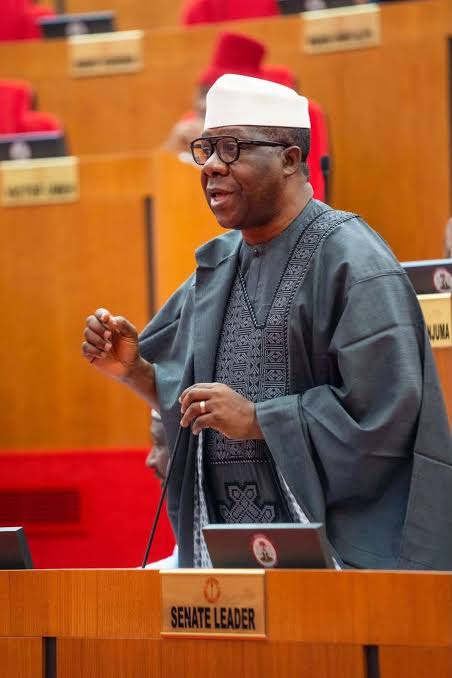
Leader of the Senate, Senator Opeyemi Bamidele, on Thursday disclosed that State Police has become a reality, as all requirements for its establishment under the Constitution of the Federal Republic of Nigeria, 1999 (as amended) have been adequately met.

Bamidele, also Vice Chairman of the Senate Committee on the Review of the 1999 Constitution, contended that the National Assembly should be judged by the impact of its initiatives and interventions and not by the volume of bills it processed and passed into law.
He made the disclosure while delivering a lecture to participants of the Senior Executive Course (SEC) 48 at the National Institute for Policy and Strategic Studies (NIPSS), Kuru, Jos, Plateau State.

The lecture was themed “Improving the Efficiency and Effectiveness of Governance through Proactive Lawmaking,” aimed at reflecting on the centrality of lawmaking to public governance.
The lecture was attended by Chairman, Senate Committee on Employment, Labour and Productivity, Senator Diket Plang; Chairman, Senate Committee on Tourism, Senator Pam Dachungyang;
Director-General of the NIPSS, Prof. Ayo Omotayo and former President, Nigerian Institution of Estate Surveyors and Valuers,
Mr. Adekunle Alonge
Delivering the lecture, Bamidele described the approval of the State Police Constitution Alteration Bill, 2026 by no fewer than 30 states as a historic milestone in the country’s collective quest to re-engineer its security architecture and make it more responsive, local and effective.
He noted that now that the constitutional threshold has been crossed, the burden of duty “now rests on the National Assembly to collate the positions of the State Houses of Assembly and pass a resolution by simple majority of members in both chambers.
“We are pleased to inform our constituents across the federation that State Police have moved from rhetoric to reality. We have already received formal reports from the State Houses of Assembly and, as of today, no fewer than 30 states have approved the State Police Constitution Alteration Bill, 2026.
“By the provision of Section 9(2) of the 1999 Constitution (as amended), which requires the concurrence of not less than two-thirds of all State Houses of Assembly, the constitutional requirement for the alteration has been duly met. This is a historic milestone in our collective quest to re-engineer our security architecture and make it more responsive, more local, and more effective.
“What happens next is procedural, but critical. The National Assembly is now constitutionally obligated to consider the reports transmitted by the State Houses of Assembly, collate those reports, and pass a resolution by simple majority of members in both chambers. Once this resolution is passed, the Alteration Bill will be transmitted to the President and Commander-in-Chief for assent.
“We have set a clear timeline for ourselves. We intend to conclude all these legislative stages — consideration of reports, passage of resolution, and transmission for presidential assent — on or before December 2026,” the Senate Leader emphasised.
Bamidele said the passage of State Police into law is no longer a campaign promise or subject of endless debate after more than 15 years of unsuccessful attempts in the National Assembly.
“What this means is that State Police is no longer a campaign promise or a subject of endless debate. It is now a constitutional reality. It means that the security of lives, private property and public assets occupies a prime place in the legislative agenda of the 10th National Assembly,” he said.
He added that Nigeria can now build a policing system that understands local terrain, speaks local languages, respects local realities, and is accountable to local communities.
Bamidele assured that the reform is not aimed at weakening the centre but at strengthening the federation. According to him, it is not about creating state armies, but about creating state-led, community-anchored policing within clear constitutional safeguards, operational standards, oversight mechanisms and human rights protections.
He said the National Assembly, under the leadership of the President of the Senate, Senator Godswill Akpabio, “remains committed to delivering on the establishment of State Police. We will not falter until every Nigerian, whether in Kuru, in Iyin-Ekiti, in Gusau or in Yenagoa, can sleep with both eyes closed.”
Also at the lecture, Bamidele noted that the 10th Assembly deliberately pursued strategic, people-centred legislation with direct bearing on citizens’ welfare.
He explained that the current National Assembly “has passed strategic legislations that will positively impact the lives of Nigerians. Among them are the Student Loans (Access to Higher Education) Act, 2024 which guarantees access to higher education for indigent students, the Minimum Wage (Amendment) Act, 2024, the four Tax Reform Acts of 2025, and the National Social Investment Programme Act.
“Others include the Electoral Act, 2026, the Cybercrimes (Amendment) Act, the Investments and Securities Act, 2025, the Nigerian Insurance Industry Reform Act, 2024, and the Regional Development Commissions Acts. In addition, work is ongoing on the State Police Constitution Alteration Bill.”
Bamidele said the legislative feats “are products of proactive lawmaking. Proactive lawmaking offers Nigeria a pathway to more effective, efficient, accountable and development-oriented governance. By anticipating emerging challenges, addressing structural weaknesses, strengthening public institutions and creating legal frameworks for innovation and reform, the Legislature can move the country from a reactive to a strategic and preventive model of governance.”
He stressed that its impact cuts across national security, economic transformation, public financial management, electoral credibility, education, healthcare, technological innovation, environmental sustainability and intergovernmental relations.
On NIPSS-National Assembly partnership, Bamidele said: “NIPSS has a special role to play in this transformation. The Institute has demonstrated capacity to bring together experienced Nigerians from the public sector, military, private sector, academia and other strategic institutions.
“Its Senior Executive Course is designed around policy, strategy, leadership, economics, international relations, security, science and technology, and peace and conflict studies. This multidisciplinary character makes NIPSS uniquely positioned to contribute to legislative foresight. I would, therefore, encourage stronger institutional collaboration between NIPSS and the National Assembly.”
He explained the imperative of making good laws, though argued that good laws did not automatically translate good governance in any democracy.
He, thus, observed that good governance “requires good laws. But good laws alone do not guarantee good governance. We require laws that are relevant, evidence-based, implementable, adequately funded, properly administered, effectively monitored, periodically reviewed and ultimately measured by their impact on citizens.”










Music star John Anderson dies at 71
Country music singer John Anderson, known for hits including Swingin’, Straight Tequila Night and Seminole Wind, has died at the...


‘Suspend frequent travels in pursuit of money and attend to me’, heavily pregnant Jarvis to Peller
“Money isn’t everything. You are chasing money more than the baby that is coming and my own mental health. Your...


BB Bucks, kisses, fake eviction: How Temi Nkem won BBNaija Season II
From BB Bucks drama and a memorable custard episode to a controversial kiss with Tram, a fake eviction and a...

Standard Chartered Raises 2026 Guidance as Q3 Profit Before Tax Jumps 29% to $2.3bn

Bamidele: State Police now reality, not rhetoric
ZJLD Group Returns to Hong Kong Wine & Dine Festival 2026

Governor Ododo renamed Kogi Specialist Hospital after late Ibrahim Idris, seeks unity

Troops rescue 2 herders, 520 livestock after heavy gunfire with bandits in ambush

22-year Nigerian model moves beyond Lagos streets into global scene
BB Bucks, kisses, fake eviction: How Temi Nkem won BBNaija Season II

PC-NCG calls for immediate cessation of unauthorized activities in the name of proposed Nigerian Coast Guard

Security: Combined security agents crush kidnappers in Kogi East, recovers dangerous weapons

BREAKING: NAF reveals identity of pilot, names of 25 dead soldiers on crashed aircraft

BREAKING: Suspected ‘Abu Odoma boys’ set Maikano Diesel Generator donated by Muri ablaze overnight at Idah LG

Research funding: Union demands 5% tax from 14 MDAs

2023: Senator Marafa, Ex-governor Yari defect to PDP
