
News
Ex-Army Chief, Attahiru’s plane crash was sabotage, high level corruption – Major General Ali-Keffi alleges

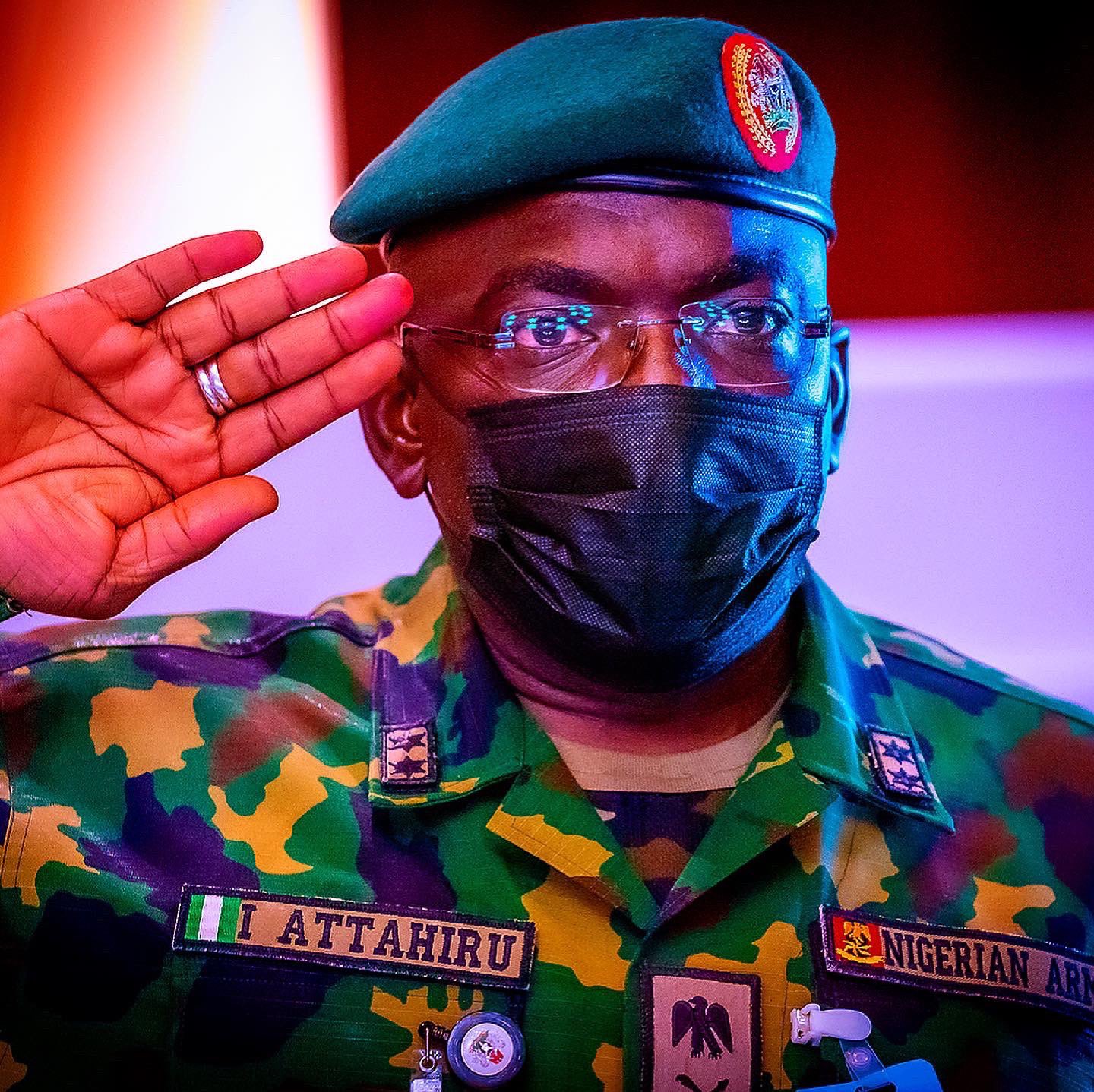
Barely five years after the death of the former Chief of Army Staff, COAS, Lieutenant General Ibrahim Attahiru in 2021 NAF Beechcraft B300 King Air 350i crash near Kaduna International Airport runway, facts emerged that his death was orchestrated through “internal hostility, operational sabotage, and high-level corruption.
Major General Danjuma Ali-Keffi, former head of the covert Operation Service Wide (OSW), made heart touching expo of how the late COAS was deliberately eliminated in the May 2021 alongside 10 other military officers in air disaster.

He said he personally observe dead bodies and discovered there was an explosion above the ground level and not crash as widely circulated.
The other victims were Brigadier-General Mohammed Abdulkadir; Brigadier-General Olatunji Olayinka; Brigadier-General Abdulrahman Kuliya; Major Lawal Aliyu Hayat; Major Nura Hamza; Flight-Lieutenant Alfred Ayodeji Olufade; Flight-Lieutenant Taiwo Olufemi Asaniyi; Sergeant Umar Saidu; Sergeant Adesina Isaiah; and Aircraftman Oyedepo Matthew.

According to Sahara Reporters, Ali-Keffi detailed the basis for his suspicion, arguing that the injuries sustained by the victims were inconsistent with a typical plane crash.
He insisted the bodies were flung far from the point of impact, and injuries on some victims, such as Major Nura Hamza having his legs “blown off” from the knees down, suggested a blast occurred inside the cabin.
In contrast, he said the bodies of the two pilots reportedly showed no burns and remained strapped to their seats, which he attributed to the armored or steel door separating the cockpit from the cabin.
He challenged authorities to examine the aircraft’s black boxes and exhume the bodies to test for explosive residue to establish the true cause of the incident.
Ali-Keffi’s account alleges that Attahiru was targeted due to his efforts to clean up corruption and sabotage within the military.
He said the late COAS had reportedly ordered a forensic audit of funds and equipment in the Army and was scheduled to act on the findings on Monday, May 24, 2021 – three days after his death. Ali-Keffi questioned the fate of this critical report.
As head of OSW, Ali-Keffi’s team had observed “massive amounts of funds meant for the counter terrorism campaign being diverted into private pockets,” and arrested terror financiers who were allegedly laundering money for senior military and government officials.
Ali-Keffi said Attahiru had confided in him about a suspected leak at Army Headquarters (AHQ) after informing a superior about intelligence on Boko Haram leader Abubakar Shekau’s hiding place in Maiduguri. An unsecured directive to capture Shekau was sent out, and Shekau immediately fled the location, leading Attahiru to suspect a tip-off.
He said Attahiru disclosed intelligence that one of his sector commanders was allegedly paying off Boko Haram fighters to avoid attacks, describing the officer as the “godson” of a powerful superior.
Ali-Keffi said, “Gen Attahiru also narrated how as Theatre Commander, he had intelligence report indicating that Shekau was hiding in a location in Maiduguri.
“Being conscious of the fact that the Army Headquarters (AHQ) had effectively hijacked control of Operation Lafiya Dole, he called a superior at AHQ and informed him of the intel.
He (Attahiru) said the reaction of the superior, as he could perceive from their WhatsApp audio conversations, was of shock and incoherence.
“He said the superior said he would call him back. To his surprise, a message was sent to him from AHQ in clear, not through a secured means of communication, that ‘Shekau had been located in Maiduguri and the TC was directed to capture or eliminate him.’
“Unsurprisingly, Shekau fled the location before the troops arrived which made Attahiru to suspect that he (Shekau) was tipped off. I nonetheless faulted Gen. Attahiru for not carrying out the raid before informing AHQ. I didn’t mention that, though, to Attahiru.
“Perhaps, Attahiru wanted to impress the AHQ, hence, the reason for alerting AHQ first. In my fairly long stay in the military, I had long suspected that a great deal of operational plans and information were leaked from headquarters; the AHQ was not an exception.”
According to him, Attahiru warned him to stay away from a particular retired senior officer whom he suspected of engaging in harmful or “diabolical” activities.
He said Attahiru frequently referred to this figure as “that man” and seemed to speak with a sense of dread whenever the individual’s name came up.
“Gen. Attahiru once warned me to be wary of a certain superior officer and I recall informing him (Attahiru) sometime in late February 2021 that the superior, who had retired at the time, had invited me to visit his private home,” he said.
“Gen. Attahiru ordered me not to go saying that the individual may harm me as he believed that the fellow was into diabolical activities. I didn’t go as ordered by the COAS.
“I recall that whenever he mentioned a certain retired superior military officer, his voice had an edge to it. He mostly referred to the fellow as ‘that man’ and never mentioned him by name.
While I wouldn’t describe Attahiru’s actions in respect of the retired superior as being fearful of the chap, I could sense a sort of dread.”
The retired general further questioned why the full report of the National Air Accident Investigation Board has never been made public, more than four years after the tragedy.
The Accident Investigation Bureau (AIB) submitted an interim report to the Chief of Air Staff in September 2021, which contained 27 initial findings and eight safety recommendations.
The AIB later stated in May 2022 that further investigation was suspended due to lack of cooperation, and that the release of the full report was ultimately the prerogative of the military.








‘Suspend frequent travels in pursuit of money and attend to me’, heavily pregnant Jarvis to Peller
“Money isn’t everything. You are chasing money more than the baby that is coming and my own mental health. Your...


BB Bucks, kisses, fake eviction: How Temi Nkem won BBNaija Season II
From BB Bucks drama and a memorable custard episode to a controversial kiss with Tram, a fake eviction and a...


22-year Nigerian model moves beyond Lagos streets into global scene
A 22-year Nigerian model Rachel Ojuromi has taken her fashion career from the streets of Lagos to the global scene....
APAC CEOs face the same AI and geopolitical pressures as their global peers but are more confident in navigating complexities
TORRAS Launches Four New Screen and Camera Protection Accessories for iPhone 18 Pro and Pro Max
TORRAS Launches Four New Ostand iPhone Cases with Built-In Stands for iPhone 18 Pro and Pro Max
Torras Ostand Q3 Vegskin Nature Iphone Case: A Premium iPhone Case Inspired by the Textures of Nature

Polaris Bank deepens sustainability commitment with tree planting at Lekki conservation centre
22-year Nigerian model moves beyond Lagos streets into global scene

Security: Combined security agents crush kidnappers in Kogi East, recovers dangerous weapons

PC-NCG calls for immediate cessation of unauthorized activities in the name of proposed Nigerian Coast Guard

Kogi East Senator Isah Jibrin commences construction of ICT centre in Ankpa

BREAKING: NAF reveals identity of pilot, names of 25 dead soldiers on crashed aircraft

BREAKING: Suspected ‘Abu Odoma boys’ set Maikano Diesel Generator donated by Muri ablaze overnight at Idah LG

Research funding: Union demands 5% tax from 14 MDAs

2023: Senator Marafa, Ex-governor Yari defect to PDP
