
Features
Mutfwang’s Birthday Gift: Rewriting Plateau’s development story through education, water, roads, traditional institutions

By Gyang Bere
In a political environment often characterised by rhetoric and symbolism, Governor Caleb Mutfwang is steadily carving a different path—one defined by practical governance, human-centred policies, and measurable impact.

For the Plateau State helmsman, politics is not an end in itself but a mission—an avenue to serve, uplift, and redefine leadership. That philosophy came into sharper focus as he marked his 61st birthday, not with elaborate celebrations, but with a series of people-oriented interventions cutting across critical sectors of development.
From revitalising primary education and expanding access to potable water, to investing in road infrastructure and strengthening traditional institutions, Mutfwang’s “birthday gift” to Plateau residents underscores a governance model anchored on legacy, not luxury.

Education as the Cornerstone
Perhaps the most striking imprint of the administration lies in the education sector, where the government has pursued an aggressive reform agenda. At the heart of this strategy is a firm belief that rebuilding Plateau must begin with fixing its public education system—particularly at the foundational level.
Available records and expert assessments suggest that the scale of investment in education under Mutfwang is unprecedented in the state’s recent history. Since the return to democracy in 1999, stakeholders argue, few administrations have demonstrated such deliberate commitment to reversing systemic decay in the sector.
To commemorate his birthday, the governor flagged off the distribution of teaching and learning materials across the state, targeting thousands of pupils in public schools. The intervention is aimed at improving access to basic instructional tools while boosting morale among young learners.
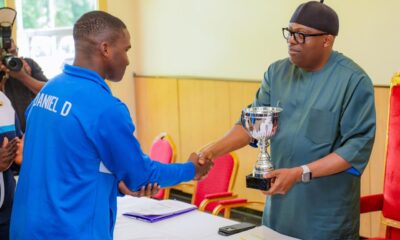
The exercise also featured the commissioning of a new administrative block and the recognition of pupils who distinguished themselves at the National Basic Education School Sports competition in Bauchi symbolic of a broader push to reward excellence and inspire ambition.
Mutfwang’s approach is rooted in a simple but powerful conviction: public education must work for the average citizen.
“We made up our minds from the onset that we must get public education right. If public education is not right, we cannot claim that education is right,” he declared.
Beyond rhetoric, the administration has backed its vision with concrete action. By clearing backlog counterpart funding obligations for 2022/2023 and 2023/2024, Plateau State regained access to critical grants from the Universal Basic Education Commission (UBEC), unlocking resources needed to address infrastructural deficits.
The results are already visible. Since 2024, the state has constructed nearly 400 classrooms, renovated over 500 others, installed dozens of motorised boreholes, and distributed tens of thousands of desks and chairs to improve the learning environment.
In addition, targeted social support initiatives have delivered textbooks, school bags, sandals, and writing materials to thousands of underprivileged pupils—an intervention designed to reduce barriers to school attendance.
Looking ahead, the administration has set ambitious targets, including the construction and renovation of hundreds more classrooms and additional water facilities in schools across the three senatorial districts.
The ultimate goal, according to the governor, is to restore public schools as the first choice for parents—a status they once held but lost over years of neglect.
Water: From Scarcity to Sustainability
Access to clean water has long been a major challenge in Plateau State, particularly in urban and peri-urban communities. But recent interventions suggest a deliberate effort to change that narrative.
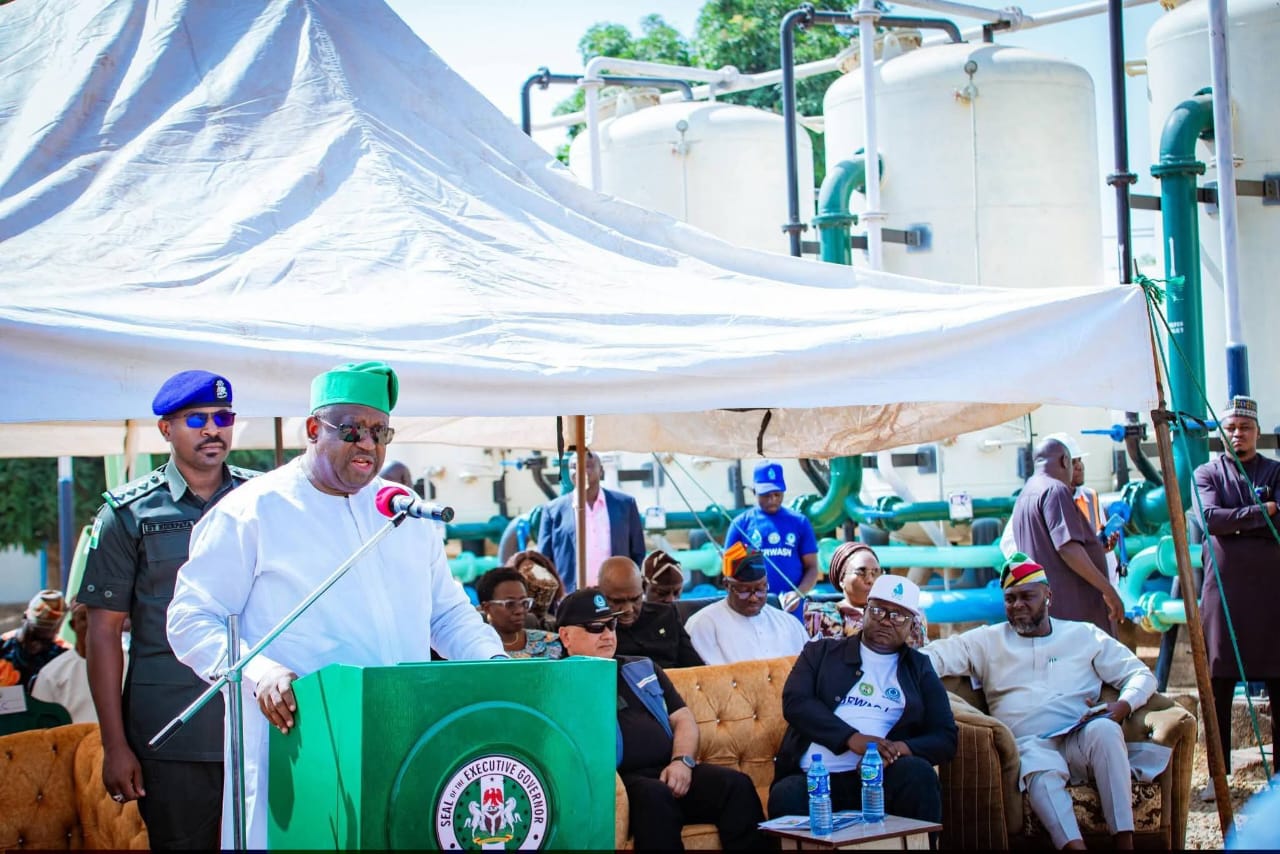
As part of his birthday activities, Mutfwang commissioned the rehabilitated Yelwa Water Treatment Plant, a project expected to significantly improve water supply to Bukuru, Gyel, and surrounding areas.
For many residents—especially women who bear the daily burden of sourcing water—the project represents more than infrastructure; it is a restoration of dignity and relief from years of hardship.
“There is no better gift on my birthday than making people happy,” the governor remarked, visibly moved by the reaction of beneficiaries.
However, the administration’s ambition goes beyond isolated interventions. In a major policy move, the state signed a multi-billion-naira contract with China Geo-Engineering Corporation and Shanxi Construction Investment Group to overhaul and expand water infrastructure.
The project, supported by financing from the French Development Agency, aims to modernise aging facilities, including components of the Laminga Dam system installed in the 1970s, while replacing obsolete pipelines across the Jos metropolis.
The significance of this initiative lies not just in improving supply, but in ensuring sustainability reducing energy inefficiencies, minimising leakages, and enhancing water quality.
Roads as Pathways to Unity
Infrastructure development under Mutfwang is not limited to water and education. The administration is also leveraging road construction as a tool for economic integration and social cohesion.
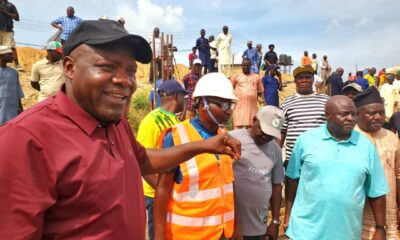
One of the flagship projects is the 17-kilometre road network linking Haske Gwafan with Kwanga communities, cutting across Jos East, Jos North, and Jos South local government areas.
Beyond easing transportation, the project is expected to connect key institutions, including schools and healthcare facilities, thereby improving access to essential services.But for the governor, the road carries deeper significance.
“By the time this road is completed, nobody will notice the boundary between Jos East, Jos North, and Jos South. It is not just about constructing roads; it is about uniting our people,” he said.
In a state historically challenged by ethno-religious divisions, such infrastructure projects double as instruments of peacebuilding—physically and symbolically bridging communities.
Reinvigorating Traditional Institutions
Recognising the enduring relevance of traditional governance structures, the administration has also taken steps to strengthen the role of traditional rulers in maintaining peace and order.
As part of the birthday commemorations, the governor presented sport utility vehicles to first-class traditional rulers—a move aimed at enhancing their mobility and operational effectiveness.
While the gesture has attracted mixed reactions in some quarters, the government maintains that it reflects a broader strategy to empower institutions that serve as custodians of culture and grassroots governance.
“Our traditional rulers remain an integral part of our leadership structure. Their role in community stability and conflict resolution is indispensable,” Mutfwang emphasised.
Beyond Optics: A Development Philosophy
Despite attempts in some quarters to downplay or misrepresent aspects of the administration’s initiatives, the broader trajectory of governance in Plateau points to a leadership focused on tangible outcomes rather than optics.
From addressing infrastructural deficits in schools to tackling water scarcity, expanding road networks, and reinforcing traditional institutions, the administration’s interventions reflect a coherent development philosophy.
At its core is a commitment to improving living standards, restoring public confidence in governance, and laying a durable foundation for economic growth and social stability.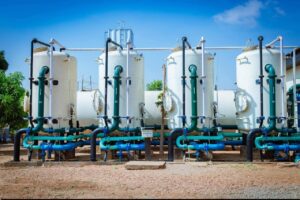
As Plateau navigates the complexities of development in a diverse and evolving society, Mutfwang’s approach offers a compelling case study in leadership—one where milestones are marked not by ceremonies, but by impact.
For many residents, that may well be the most meaningful birthday gift of all.







BB Bucks, kisses, fake eviction: How Temi Nkem won BBNaija Season II
From BB Bucks drama and a memorable custard episode to a controversial kiss with Tram, a fake eviction and a...

22-year Nigerian model moves beyond Lagos streets into global scene
A 22-year Nigerian model Rachel Ojuromi has taken her fashion career from the streets of Lagos to the global scene....


Geh Geh lashes Burna Boy over ₦9bn Bugatti, demands youth empowerment
Social commentator Geh Geh has criticised Afrobeats star Burna Boy over his newly acquired customised Bugatti Chiron VXX, reportedly valued...

Together, We Transform 60+: Alpro Group Advance Early Thyroid Detection for Ageing Malaysians

Ukraine launches 1,000 drones at Russia, attacks set St. Petersburg oil facilities on fire

Irate Zamfara youths unleash anger on Deputy Governor over prolonged insecurity

Go Where Flavors of Hunan Abound: Showcasing the Greater Zhangjiajie International Tourism Area Through Local Cuisine

Fubara condoles late Ambassador Dele Cole, says he was an accomplished journalist, diolomat

Security: Combined security agents crush kidnappers in Kogi East, recovers dangerous weapons
22-year Nigerian model moves beyond Lagos streets into global scene

Kogi East Senator Isah Jibrin commences construction of ICT centre in Ankpa

PC-NCG calls for immediate cessation of unauthorized activities in the name of proposed Nigerian Coast Guard

BREAKING: NAF reveals identity of pilot, names of 25 dead soldiers on crashed aircraft

BREAKING: Suspected ‘Abu Odoma boys’ set Maikano Diesel Generator donated by Muri ablaze overnight at Idah LG

Research funding: Union demands 5% tax from 14 MDAs

2023: Senator Marafa, Ex-governor Yari defect to PDP
