
Politics
APC support group seeks continuity, stronger institutions for Nigeria’s democracy


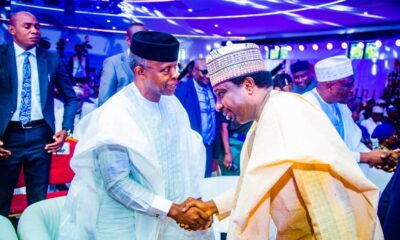
The National Progressive Hub (NPH), a political support group affiliated with the All Progressives Congress (APC), has called for continuity in governance and stronger democratic institutions to secure Nigeria’s future.
The group made the call on Thursday during its annual national town hall summit held in Abuja with the theme: “Pathway for a Sustainable Democracy and the Way Forward for the Renewed Hope Administration and Policies.”

The Hub emphasized that democracy is more than a system of government, noting that it requires collective action to ensure it endures, evolves, and serves the needs of all Nigerians.
Delivering the keynote address, former New Nigeria Peoples Party (NNPP) Chairman and APC chieftain, Prof. Rufai Alkali, highlighted the challenges confronting Nigeria’s democratic journey and proposed reforms to strengthen governance.

He cautioned that Nigeria’s democratic institutions are facing mounting pressure.
“Our institutions are under attack. Political parties, for instance, lack internal democracy and often embrace the culture of imposition and godfatherism. Because of internal struggles for power, due process is usually ignored,” Alkali said.
He urged politicians to resist the temptation of demonizing institutions, stressing that collective efforts are needed to build the country to greater heights.
Similarly, the Director-General of the Tinubu Support Group, Dr. Umar Tanko Yakasai, underscored the importance of policy continuity for national stability.
“In a country as diverse and heterogeneous as Nigeria, everyone must have a sense of belonging. Continuity in governance allows policies to mature and produce results, while fairness ensures that all groups feel equally treated,” Yakasai stated.
Convener of the summit, Hon. Bukie Okangbe, stressed the need for women’s inclusion in governance, describing it as central to deepening democracy.
“Women are not a minority. They are more than half Nigeria’s population, and yet they remain underrepresented in parliaments, cabinets, boardrooms, and decision-making spaces. This is not just a gender issue—it’s a democracy issue,” she declared.
According to her, “A democracy that excludes half its people is incomplete. A democracy that listens to women only after decisions are made is not inclusive. And a democracy that seeks to empower women without sharing real power with them is not just.
“We don’t need policies that simply speak about women—we need policies shaped by women. We need systems that don’t just accommodate women’s voices, but are built upon them.
“So let us move beyond tokenism. Let us ensure that women are not just at the table, but leading the conversation. Because true democracy cannot exist without equality, and equality cannot exist without women.”
She further emphasized that democracy belongs to the people and that politicians must remain accountable to voters.
“Politicians don’t own democracy. The people own it. Politicians must always give account to those who sent them to office. We must also stop demonizing every institution — the judiciary, INEC, the police — because that only weakens democracy,” she said.








Music star John Anderson dies at 71
Country music singer John Anderson, known for hits including Swingin’, Straight Tequila Night and Seminole Wind, has died at the...


‘Suspend frequent travels in pursuit of money and attend to me’, heavily pregnant Jarvis to Peller
“Money isn’t everything. You are chasing money more than the baby that is coming and my own mental health. Your...


BB Bucks, kisses, fake eviction: How Temi Nkem won BBNaija Season II
From BB Bucks drama and a memorable custard episode to a controversial kiss with Tram, a fake eviction and a...

Israel Election 2026 Netanyahu’s Likud alleges Arab parties ‘stole’ Israeli election, demands investigation
BAIC FOTON Africa Regional Training Center Opens, Strengthening Local Service

Fubara urges traditional rulers to be “fathers to all”

Barau tackles Osinbajo over depressing economy under Tinubu comment, says challenges being addressed

2027: Obi reveals what will happen to election riggers if he wins

22-year Nigerian model moves beyond Lagos streets into global scene

PC-NCG calls for immediate cessation of unauthorized activities in the name of proposed Nigerian Coast Guard

Security: Combined security agents crush kidnappers in Kogi East, recovers dangerous weapons
BB Bucks, kisses, fake eviction: How Temi Nkem won BBNaija Season II

BREAKING: NAF reveals identity of pilot, names of 25 dead soldiers on crashed aircraft

BREAKING: Suspected ‘Abu Odoma boys’ set Maikano Diesel Generator donated by Muri ablaze overnight at Idah LG

Research funding: Union demands 5% tax from 14 MDAs

2023: Senator Marafa, Ex-governor Yari defect to PDP
